Addison: the original Spectator
My debt to its first - and greatest - editor

At home, I have every issue of The Spectator - its first iteration from 1711-12. It’s one of the most expensive things I’ve bought and still gives me no end of pleasure and inspiration. The Spectator that you see today is the oldest weekly in the world, but that is dating it back to the current run from July 1828. The original — and the inspiration behind the reboot of The Spectator — was the 1711 edition created by Joseph Addison, a Whig politician and his womanising mate, Dick Steele.
As editor, I sought to samples the DNA of what was created by those two back then then project it on multiple platforms. That, in a nutshell, was my strategy as editor.
Steele ran Tatler as a one-page paper consisting of a single comment piece. When Addison started to come available (they were together at Charterhouse) he junked it and set up The Spectator. But the two papers were identical in tone, layout and style. The subjects would range from foreign affairs, theatre and book reviews, the classics, life and love. It was a crazy, quixotic project that ought to have failed — but it succeeded, to a degree never seen by any publication before. Or since.
The Addison Spectator was a revolution. Addison was the greatest Latin scholar of his generation, Magdalene College prodigy who was active at a time when the world was crazy for rediscovering classics. Every Spectator started with a Latin or Greek quote, and often delved into antiquity to make the point. This made him the first great media man, a legacy of work republished world over - so popular in 1828 that a Scot, RS Rintoul, decided to reboot the project. Even in the 1960s, schoolkids were being given Addison Spectators to study - but he has since slipped out of vogue. So I’d like to say a bit about him here, and how he wrote the blueprint I sought to rediscover and follow.
The rise of the coffee house
What makes a publication’s success? Writing, tech, audience. Development in any of the three can lead to a breakthrough. Addison, a brilliant essayist, provided the words. A guy called Sam Buckley had the printing technology (more about him later) but the new breed of coffee houses provided the audience.
The coffee houses represented a social revolution: before, high-level debate had been confined to university quads and royal courts. But the Glorious Revolution of 1688 had created the conditions for a massive economic expansion and the rise of a new kind of man. One who would pay to read, and to learn - and who wanted, above all else, the knowledge that (at the time) was only given to the highborn.
For the first time in history, writers (like Addison) could be funded by readers (as opposed to a patron) and the basis of journalism was created. These readers gathered in coffee houses, keen to learn and debate. “The coffee house was the precursor of the modern office,” writes John Brewer. “But once you were there, you were as likely to talk about matters of general interest – the latest play, sexual scandal or political quarrel – as carry on business.”
They came to drink, gossip and debate – and needed fodder for this debate. The conditions were perfect for the emergence of The Spectator.
During the reign of Queen Anne (the ‘old queen’ referred to in its current address, 22 Old Queen Street) London was in the opening flush of the Enlightenment, a city given over to pleasures of the imagination. Before, the old landed families had the education — but there was no way of acquiring it unless you were born into wealth. So great writers spent their time on the scrounge, looking for patrons. This was changing with the emergence of a middle class. Addison saw that the yuppies were not revolutionaries. They didn’t want to supplant the landed fox hunting class, but join them. He welcomed the world of free trade and the opportunities it brought. He teased the members of the gentry who grumbled against ‘the inconveniences of trade, that carried from us the commodities of our country and made a parcel of upstarts as rich as men of the most ancient families of England.’ Addison was on Team Upstart, but his point was that there need not be (another) civil war: the two can learn to coexist. And could do so through agreeing to disagree, learning from each other — and do so by the medium of satire and humour.
What’s more, the upstarts wanted to sup with, rather than supplant, the Tory squires. A middle class was being created: they had wealth, but no classical education. They craved it, and Addison — a poet, politician and arguably one of the greatest Latin scholars of his generation — was able to provide it. His Spectator was not angry or partisan. Neither is today’s.
London’s newspaper scene, meanwhile, was thriving due to the accidental end of state censorship. The Licensing Act had been allowed to lapse in 1695 (by a parliamentary cock-up) and hundreds of publications exploded on to the London scene. (Quite a contrast with France where hundreds of pre-publication censors were at work throughout the century.) This was at a time when learning, debate and culture was moving from royal courts and university quads into the new breed of coffee houses where people gathered to debate.
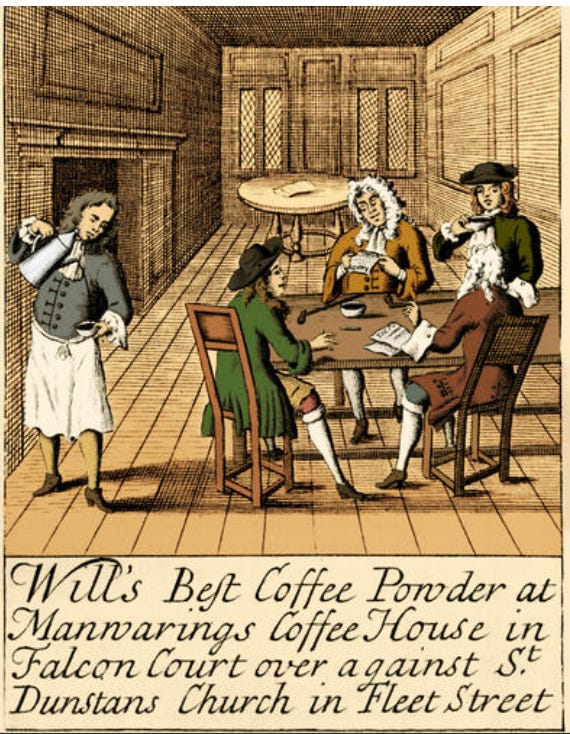
It’s hard to describe, now, what these coffee houses were like. Different groups of people — thespians, merchants, Whigs, poets and Tories — would meet in different coffee houses to exchange conversation and ideas. There were no offices in those days, so people quite often worked from the coffee house table. Lloyd’s insurance grew out of Lloyd’s coffee shop; Samuel Johnson’s Lives of the Poets was commissioned in a coffee shop. The price of admission was a one penny but the real commodity sold was conversation. The coffee houses were sometimes called the ‘penny universities’ because if you paid a penny, you were set up there all day long.
If someone was in town and wanted to find Dryden, one of England’s greatest poets, they’d be sent to Will’s Coffee House, where he held court. (The 11-year-old Alexander Pope sought Dryden out in this way.) As Macaulay later put it, the coffee house was the Londoner’s home ‘and those who wished to find a gentleman commonly asked not whether he lived in Fleet Street or Chancery Lane but whether he frequented the Grecian or the Rainbow’.
One contemporary account sums it up perfectly:-
“Coffee-houses make all sorts of people sociable. The rich and the poor meet together, as also do the learned and unlearned. It improves arts, merchandise, and all other knowledge; for here an inquisitive man, that aims at good learning, may get more in an evening than he shall by Books in a month. He may in short space gain the pith and marrow of the others reading and studies. I have heard a worthy friend of mine who was of good learning say, that he did think, that coffee-houses had improved useful knowledge, as much as [the universities] have, and spake in no way of slight to them neither,”
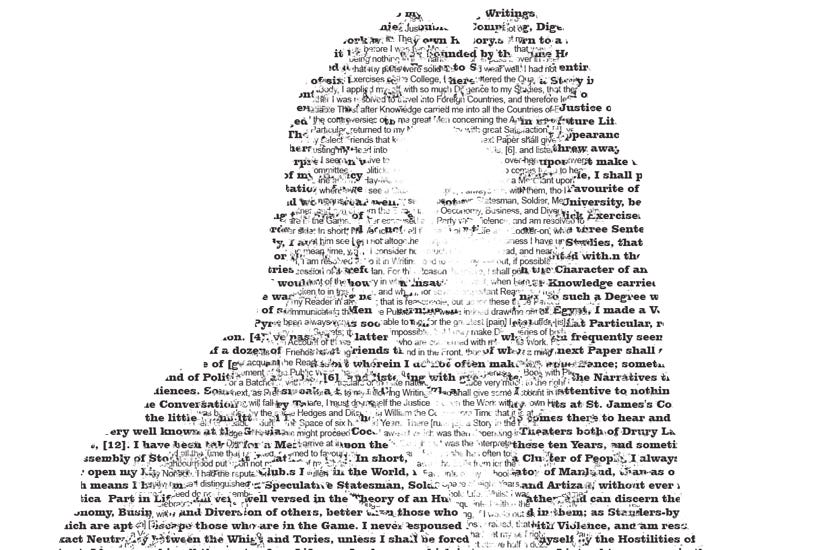
You can get a sense of the coffee house scene from the letters and memoirs of the time. William Defoe once wrote that ‘After the play. the best company generally go to Tom’s and Will’s coffee houses, near adjoining, where there is playing at picquet and the best of conversation till midnight.’ But crucially, you didn’t have to join in the conversation. You could just listen — or spectate. (For all his eloquence, Addison was an awful public speaker — a deficiency for which he was much mocked in his brief career as an MP.) This was the idea for The Spectator: someone who drops by the best coffee houses in London, who listens and then shares the ideas with a readership. The first-ever edition of The Spectator, pictured above, spelt this out. It was written in the name of Mr Spectator who declared…
There is no place of general resort where I do not often make an appearance. I am seen thrusting my head into a round of politicians at Will’s. Sometimes I smoke a pipe at Child’s and overhead the conversation of every table in the room. I appear on Sunday nights in St James’s Coffee House, and sometimes join the little committee of politics in the Inner Room. My face is likewise very well-known at the Grecian and the Cocoa-Tree.
And this mattered because it was rare to visit them all because in those days a Whig would not turn up to the Cocoa-Tree any more than a Tory would be seen at the Coffee House in St James’s. But no fear: we had, in Mr Spectator, someone who was interested in high-quality debate whatever the orientation. And someone who also excoriated partisanship, regarding it as a poison that undermined civility, killed off wit and impeded the free exchange of ideas. At a time when social media partisanship can force everyone to extremes, the Addison formula for keeping it civil — using humour and rigour and giving space to all sides of the argument — is certainly useful today. It was my guide to veto partisanship and politicisation: The Spectator has always defined itself against this.
Then, as now, most publications came from a partisan angle: Jonathan Swift’s Tory Examiner, for example, lambasted everyone from a Tory perspective. Addison had responded to it with a (better-written) Whig Examiner but then gave up. He didn’t just hate Swift’s spiel, but the whole reductive notion of partisan writing. This, he thought, was the real enemy.
Addison’s Spectator explicitly sought to rise above this and make space for all arguments. It’s ridiculous to claim that a publication devoted to opinion and ideas can be neutral: the 1711 Spectator had a Whiggish bent (especially when Addison was away and Steele was editing). But Addison realised the road of partisanship was a short one, and not just alienated a chunk of potential readership but insulted the intelligence of people who like ideas. His Spectator was a rebuke not to Toryism but culture wars and partisanship.
Its pages introduced (fictional) characters of opposing views in civil, humourous conversation with each other. Sir Roger De Coverely, a landed Tory whose old world was rapidly ageing. Andrew Freeport, an upstart trader and Whig. There was Will Honeycomb, an affable man-about-town, and more such characters who attracted a soap-opera following. The Spectator set out to introduce the notion of politeness: then, a revolutionary concept. (Melvyn Bragg once did an In Our Time on The Spectator and the notion of politeness: listen here.) A kind of framework for civil discussion, much needed in a country where the embers of the civil war were still glowing. Richard Cromwell, former Lord Protector, was still alive in 1711. And the prospect of a Jacobite rebellion was looming,
Addison used The Spectator to denounce the poison of partisanship and promote the idea of friendly discussion between rivals. This is, today, a vital part of the magazine: readers like well-written articles with which they disagree. In The Spectator edition number 244, there is a quote that I posted on my fridge at home.
A man must be excessively stupid, as well as uncharitable, who believes that there is no virtue but on his own side and that there are not men as honest as himself who may differ from him in political principles.
Addison referred to tribalism as ‘false wit’. True wit — original, independent, elegant — was harder to find. So how would you fill a magazine if not with news from around the world to agitate people? His concept was to have a magazine that would care as much about books, the arts, philosophy and life as it did about political events. As we do now. From Spectator edition ten:
Is it not much better to be let into the Knowledge of ones-self — than to hear what passes in Muscovy or Poland. Is it not better to amuse ourselves with such Writings as tend to the wearing out of Ignorance; Passion, and Prejudice — than such as naturally conduce to inflame Hatreds, and make Enmities irreconcilable.
This was The Spectator’s project in 1711: to break away from partisan rants and skirmishes. To be ‘more of a cocktail party than a political party’ (a quote from Alexander Chancellor, whose 1970s editorship saved the magazine). Addison wanted The Spectator’s loyalties to lie not with any party, but with elegance of expression, originality of thought and independence of opinion. These remain the principles behind The Spectator today. Addison despised partisan writing and his Spectator railed against ‘the mischief’ that saw trolls (or their equivalent) ‘spoil good neighbourhood and make honest gentlemen hate on another’. He’d have loathed today’s Brexit partisanship. Yes, you can take a view. But never in a way that portrays your opponent as confused or malign.
The sheer variety of Addison’s Spectator marked it out. At the time, newspapers had very little comment in them. Opinion sheets tended to bang on about politics but in The Spectator, the arts and literature and classics mattered more. Addison devoted several Saturday editions of The Spectator to Milton’s Paradise Lost — and in doing so, he transformed an almost-unknown poem (ignored after its publication 40 years earlier) into one of the most popular classics of the English language. Each edition of today’s Spectator gives at least twice as much coverage to books and arts as it does politics. Addison roped in others to his project: Eustace Budgell, who popularised the idea of the ‘prime minister’ (originally a term of abuse, mocking ministers who had risen above their official role) and the poets Thomas Parnell and Thomas Tickell. It gave plenty of space to the original poetry, as we do today. The Spectator of 14 May 1712 is given over to a poem by ‘a great genius, a friend of mine’ — but unnamed. It was Messiah, by the 23-year-old Alexander Pope.
Ancient and modern
Addison saw, in the classics, not just the greatest collection of writing ever written but the greatest collection that could be written. This is what everyone thought at the time: English was crap, and incapable of expressing great writing. Shakespeare, for example, was not really rated. Addison sought to make the classics more accessible, which is why he opened each issue of The Spectator with a quote from Homer, Horace etc: but always in the original Latin or Greek. To translate, he thought, would be to vulgarise. His readers could either understand the original or aspired to learn.
Addison only ever saw himself as a populariser, a kind of tabloid hack bringing the beauty and notions of the classics available to those who did not speak the original language. In Spectator number ten, he declared that
It was said of Socrates, that he brought Philosophy down from Heaven, to inhabit among Men; and I shall be ambitious to have it said of me, that I have brought Philosophy out of Closets and Libraries, Schools and Colleges, to dwell in Clubs and Assemblies, at Tea-tables, and in Coffee houses.
This was, at once, a high-minded and a base aspiration. Addison wanted to take the highest quality of ideas, arguments, classical references — but serve them up in a way that could be eagerly digested by any bloke (or, importantly for his Spectator, woman) who walked into the coffee house. He rejected the idea that the classics were historical, or that you needed to be a clergyman or a specialist to understand their beauty.
Boris Johnson has said that there’s no experience or emotion in life that cannot be found in the Ilyad (which, when he is in trouble, he recites in the original ancient Greek). I’d say the same about Sex & The City. But in 1711, the classics was not part of education: it was education. And a huge number of self-made men sought it. No one had succeeded in translating the classics into English before but this was being done for the first time (by Dryden, Pope etc) prompting a kind of big bang for the English language. Establishing its potential to convey wisdom and beauty.
The rise of English
Addison was part of that big bang, not that he saw it. He made the English language do things it had never done before, including becoming an instrument for social thought. But even he didn’t think anything decent could be written in English because the basic materials — the words, the syntax, the verb patterns — were just a bit lame. Milton was great, he said, but to compare anything written in English to the classics was to compare a palace made with brick to one made of marble (‘the materials are of a courser nature’).
But under Addison, those bricks were being turned into marble by a new breed of craftsmen. And they sought support not from a royal court or a benefactor, as all writers had to do beforehand: they now had punters willing to buy, and spend a lot. It’s a crucial point. The market was proving itself more effective patron of the arts than any nobleman had done hitherto. Addison had a huge belief in a popular market for classics: a notion that snobs, then and now, laugh off: why would the plebs want to read Homer? But they did. Ideally in English. Addison’s friend Alexander Pope was to prove this market a few years later when he used his fame to ask for sponsorship to transcribe the Ilyad. It became a publishing sensation and set him up for life.
Humour vs pomposity
Almost all of The Spectator’s essays — not just those of Addison and Steele — were humorous. Some were rude or even outrageous, but the tone mattered: it was a vehicle for exploring incendiary topics without getting swivel-eyed. Humour was the medium for a proper exchange of ideas, the antidote to tribalism (or ‘enthusiasm’, as Addison called it). Addison ‘presented knowledge in the most alluring form’, wrote Johnson, ‘not lofty and austere but accessible and familiar’. Humour is the antidote to tribal rage. Today’s Spectator always leads on a cartoon.
Addison’s Spectator didn’t last long. Government regulation meant a new tax (to fund a national lottery) meant the end the year after it started. Addison and Steele steadily killed off their characters — Sir Roger de Coverely passed away (and was anyway depicted as being lost in a new world where people were judged by performance, not by birth). Sir Andrew Freeport moved away, Will Honeycomb caught the clap.
Only after it closed did Addison and Steele’s magazine enter immortality. And why? Because of Sam Buckley, who was the George Martin to their Lennon and McCartney. Buckley was perhaps the only printer in London who had a press able to produce a daily opinion sheet.
As Rupert Murdoch has always understood, new technology and new audiences are always the handmaidens of journalistic innovation. In 1711, coffee houses provided the audience and Sam Buckley provided the tech. When it folded, he paid £500 for the copyright to the series, because he had worked something out. The short lifespan of The Spectator was a virtue: every article could now be reprinted in about eight small volumes. They were a sensation and were never out of print for the next two centuries. My house is full of them (as is eBay). I found a Buckley original once, The Spectator prototype: just the first volume. I gave it as a wedding present to Lara Prendergast: a brilliant editor. Without editors and publishers, writing would go nowhere.
As the decades went on and the middle class expanded, the market for these multivolume copies of The Spectator just kept on growing — in Britain and abroad. They were in every educated house in England and the United States. Benjamin Franklin said that he taught himself how to write, talk and argue by reading The Spectator. Samuel Johnson summed it up by saying that anyone who wanted to learn how to combine wit with flair should ‘give his days and nights to the study of Addison’. At one stage, the French translation of Addison’s Spectator was the most-read book in France. Jane Austen describes her characters reading volumes of The Spectator.
One of the reasons that I collect reprints is to read the introductions and see how Addison’s writing (unsigned at the time) grew in stature as the decades went on. A 1956 edition says The Spectator was ‘second only to the bible in its influence on British manners and morals, the most popular model for English prose composition’. My most treasured reprint is in 1827, because this, or one very like it, will have been what inspired the 1828 Spectator that we work for now.
You can see why the project was restarted. If everyone in 1828 was crazy about the Addison formula — wit and style, politics and poetry — why not resurrect it? So in July 1828, a Dundonian printer named Stephen Rintoul did just that. The links between his magazine and that of Addison and Steele are outlined here by professor David Butterfield, who has written a brilliant history of the 1828 Spectator.
So I worked out pretty early on as editor that this would not be, in any real way, my magazine. It had its own trajectory, its own values, its own voice. And always will.
Many thanks, Fraser. Fine summary of a great inheritance.
Fascinating piece, thanks Fraser!