Andy Burnham's promising first week
Tax cuts, North Sea drilling, abolishing ID cards - what's not to like?

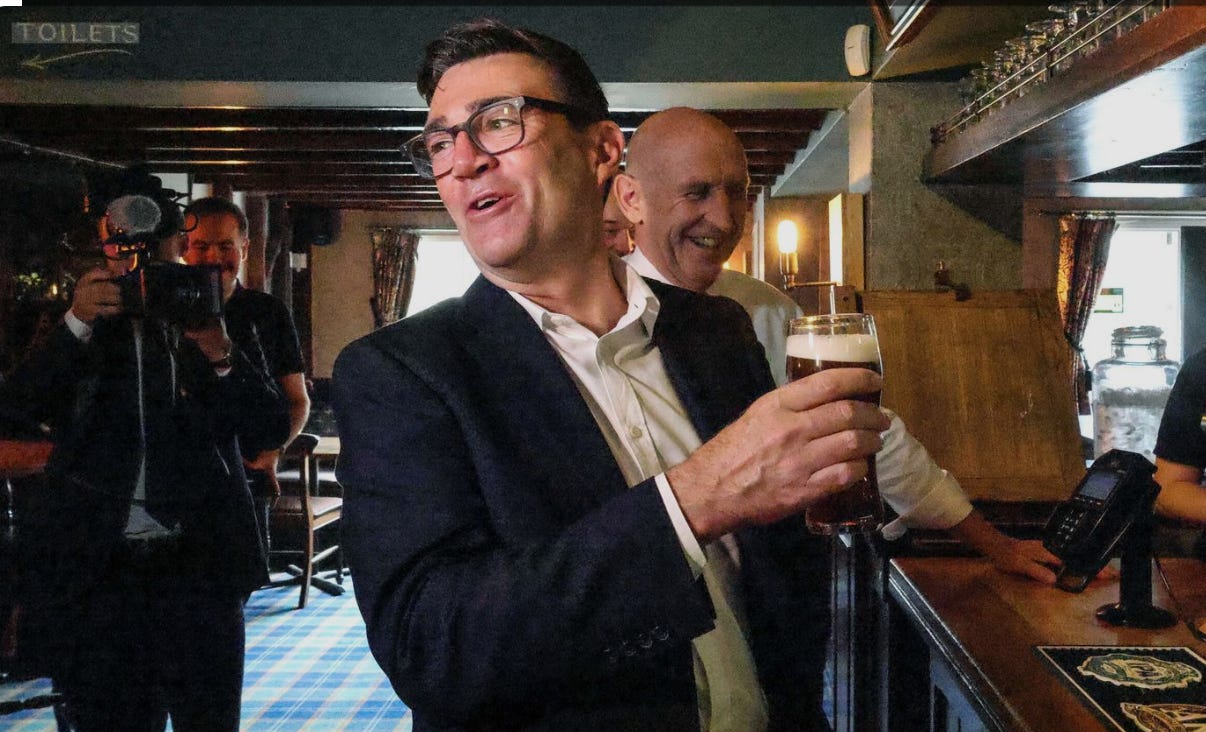
We have very little idea what Andy Burnham believes or will do. Perhaps he believes his ‘40 years of neoliberalism’ language and will act accordingly. Or perhaps it’s verbiage to draw helpful fire from the right and win back left voters. We have seen this model before - say crazy stuff, do sensible stuff - and it’s best not to fall for it. Don’t rise to the bait. Pay more attention to what Burnham does than what he says. In my Times column I say that what he has done has been good. He has cut wasteful schemes, cut tax, suspended prison early-release. So far, his words form a different pattern to his deeds - but in an encouraging way.
Let’s look at his announcements.
North Sea drilling. From any perspective - including a green one - giving production consent for Jackdaw and Rosebank is a no-brainer. Both Adura gas fields are licensed, so Burnham can complete the approval process without breaking Labour’s manifesto pledge not to license any new North Sea projects. Jackdaw could provide about 6pc of annual UK gas production. It won’t help energy prices, which thanks to Iran madness, are soaring. But Burnham is signalling a pro-jobs, pro-domestic-production break with Miliband.
Use Brexit powers to cut VAT on electricity. EU member states are not allowed to reduce VAT on electricity below 5pc; Burnham has cut it to zero from October, saving the average household £45/year. (No tax cut for Northern Ireland, which still has to follow EU VAT rules). When Reeves cut holiday-home tax she stayed within limits that would have been allowed by the EU to avoid being seen to use Brexit powers. Burnham doesn’t care. He needs to go further - green policies still add roughly £140/year to typical electricity bills. But the VAT cut is in the right direction.
Tax cuts for pubs a 20pc business-rates discount from April 2027. A deserving cause. I used to be a barman in Cleos in Rosyth, a shipyard town where the bar helped keep people and communities together. Such pubs have now closed, and drugs/alcohol deaths there have surged. We should be doing all we can to save pubs and Burnham’s cut in their business rates is a small step in the right direction. Let’s remember: out of every £100 spent in a pub, the government takes £27 and landlord keeps £1.35 (details below). This will rise to £1.44 under Burnham, worth ~£1k/year to a typical pub.
Abolishing Starmer’s identity card scheme. Burnham is not at all close to Tony Blair; in ‘40 years of neoliberalism’ critique seems directed at Blair (who, in turn, dead-names Burnham as ‘Andrew’). The lack of relationship has made it easier for him to ditch identity cards, a Blair favourite. This policy would do nothing to control undocumented migration as evidence from the continent shows.
A decent reshuffle. Shabana Mahmood stays at Home; she’d have been a good Chancellor but is best where she is. Hermer and Philipson out. As Chancellor, John Healey will look foolish if he doesn’t now give defence what it wanted when he resigned. I have no idea how Burnham will pay for all this but the above priorities are the correct ones.
I hold no brief for Burnham. I found his homelessness pledge unconvincing. I thought the £2 bus cap was a gimmick when the Tories proposed it and think it’s daft now that he proposes it. I find his ‘Andy goes to Westminster’ schtick odd. He grew up in Culcheth, a lovely Warrington village in the most prosperous 2pc of English neighbourhoods according to IMD rankings. From there to Cambridge, so our plucky outsider has been marinated in the English elite since he was a teenager; groomed for power. The variety he offers comes from his status as a Cambridge man, interrupting Oxford’s run. Thus the great boat race of British politics continues.

His theatricality is grating, and seems to denote the politics of personal obsession rather than national service. But he’ll see this as a tool. power now seems to go to only two types of politicians: the larger-than-life characters (Meloni, Trump, Boris) and the technocrats who defy all of that (Scholz, Starmer, Carney). For his 24 years in Westminster, Burnham was in the latter category and has returned in the former, with a whole new style of politics. When he was elected for Makerfield standing next to a man in a fox suit and Count Binface (above) it was worth noting that all three gentlemen were in costume. Burnham in his jacket and dark t-shirt. He’s working the new personality-based politics for the short-form video social-media age. He’s doing it well.
Perhaps his ‘40 years of neoliberalism’ verbiage provides political cover for the tax cuts and drilling. Perhaps I underestimated him. I certainly hope so. What we have seen so far have been small - promissory notes, he says - and they may yet turn out to be a ruse, a prelude to a Red October budget rinsing the south. But let’s judge him by what he does. So far, and against my expectations, it’s a good start.
PS A note on the economics of pubs.
A reader writes in below to query the pub figures. Here they are. Of every £100 a customer spends at the pub, the landlord ends up keeping just £1.35 as profit after tax, once everything else is stripped out. VAT: £16.67. Alcohol duty (embedded in drink prices) accounts ~£5.75. Employer NI and other staff-related taxes take about £3.61. Business rates take 50p and after 32p corporation tax the government's total take is around £26.80 per £100 spent.
Of the rest, about £70 goes to drink and food suppliers, staff wages (inc landlord salary), rent, energy and other running costs. What's left over after all of that is the £1.35 the pub actually keeps as profit after tax. A miserable return for the risk ,Hence the collapse of pubs. Much more help is needed.
You writw "thanks to Iran madness…" Surely you mean U.S.A. madness?
£3 to £2 bus doesn’t make much difference but I was paying £12 daily vs £2 daily. With no local train stations thanks to Beecham and buses the only choice, £10 a day saving is far from a gimmick.