How civilisations fall
Some reflections from the Camino - and from Johan Norberg's Peak Human

The final approach to Santiago de Compostela feels designed for those who’ve walked days, weeks, even months to get there. The milestones, which begin 700km away, vanish at the last kilometer as the cathedral spire comes into view. On the pavement appear quotes — one of which stuck with me when I finished a few days ago: “Europe was made on the pilgrim road to Compostela.” My picture below:-
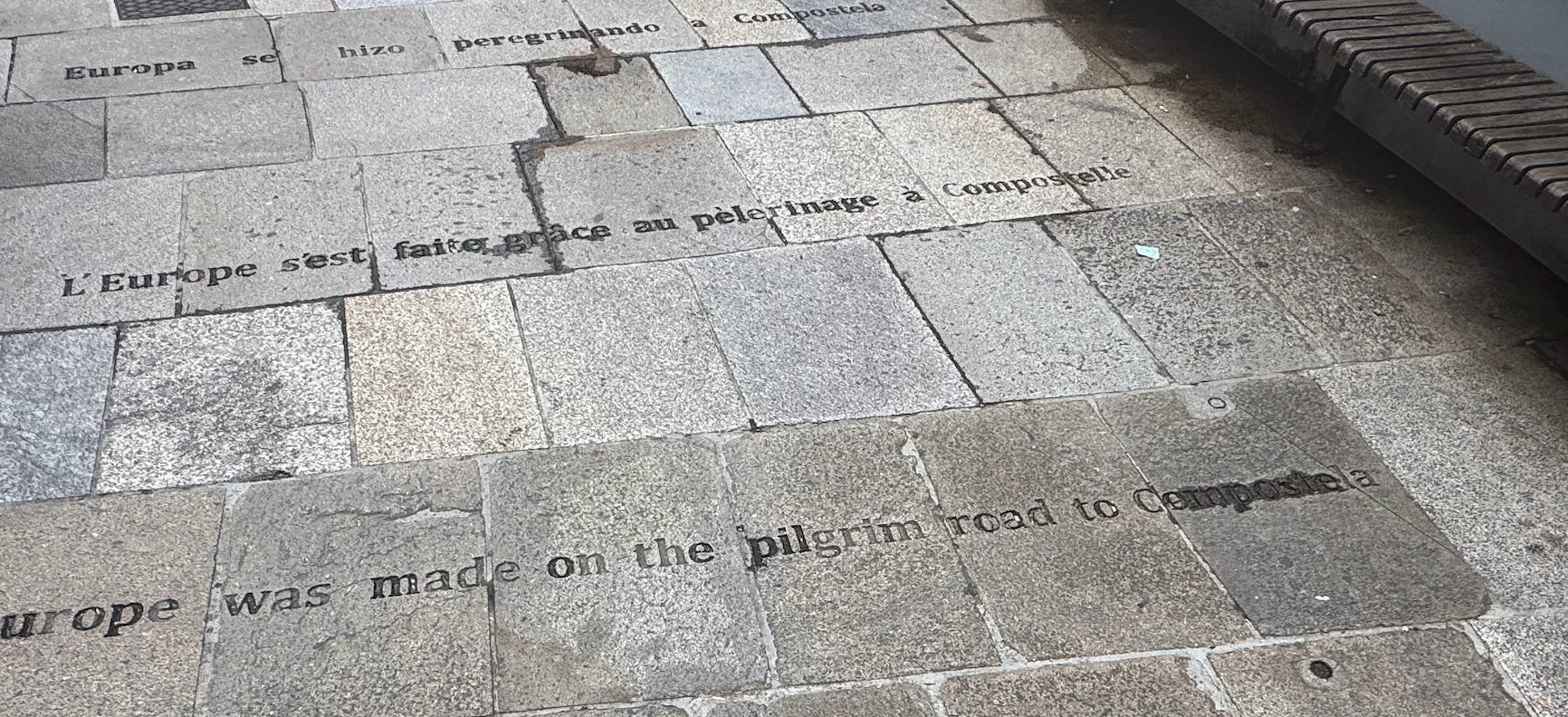
The full quote (misattributed to Goethe) is that “Europe was born on pilgrimage, and Christianity is its mother tongue.” This idea of a Europe created by Christian faith is back in vogue, with the likes of Viktor Orban and Vladimir Putin presenting themselves as defenders of Christendom - battling the forces of wokism, the LGBT agenda and (of course) Islam. The MAGA movement has started to say it champions ‘Western Civilization’ - sometimes referred to as Judao-Christian to hammer home who it excludes: the Muslisms. Politicians who are not known to be religious are now making similar noises. Steve Bannon and Jack Posobiec recite dates on their podcasts with "the year of our Lord" and "Anno Domini." Robert Jenrick recently berated No10 for not commemorating what he called ‘Psalm’ (rather than Palm) Sunday. We see Christianity being co-opted to certain elements of right-wing politics.
But it wasn’t Christianity that made the West great: it was openness and liberal values. That’s a theme of Johan Norberg’s new boom, Peak Human. It’s a history not just of the West but of decline and fall: what makes civilisations great, and what leads to their downfall.
The original Open Europe
The camino was transformative not just spiritually, but as Europe’s original information superhighway. Over centuries, it became a network where gossip, innovation, heresy, and new ideas traveled on foot. Medieval pilgrims from across Europe, speaking Latin, Spanish, and local dialects. They will have met in communal hostels, shared meals, and exchanged insights — setting in motion the intellectual restlessness that helped awaken Europe from the Dark Ages.
Norberg argues that Europe’s golden ages were created not by geography, ethnicity, or military might, but by openness. At a time of panic and rising protectionism and illiberalism, it’s a book that’s as much about the present as the past.
Unlike China or the Islamic caliphates, Europe never unified under a single emperor. It remained a chaotic mix of kingdoms, bishoprics, merchant republics, and tiny principalities. But this fragmentation, this beautiful difference, this huge variety of languages and cultures was (and remains) the great European advantage. “It looked less like the Roman, Abbasid and Chinese empires, and more like the classical Greek abundance of competing city-states, always fighting but also constantly learning and trading,” Norberg writes. Spain itself was split between Christendom and Islam.
So no single European ruler could clamp down on innovation (as happened in China). New ideas could always survive somewhere: a heretical thinker might be persecuted in Paris but find refuge in Florence. A radical invention might be ignored in Seville but embraced in Amsterdam.
Europe’s Pax Islamica
What really jumped out at me in Johan’s book was the way that the Islamic empire also expanded by its openness, by tolerating minority religions in a way that conquering Christendom did not. “To you, your religion” the Quaran says: “To me, mine.” I had no idea, for example, that 9th-century Baghdad had 100 bookstores, which would not have been possible if only the rich read books. They hoovered up ancient wisdom, translating text from antiquity at a time when much of Christian Europe was ruled by people who could not write their name - the Islamic part of Europe (based in what is now Andalusia) was the more advanced civilisation. As Tom Holland shows, Islamic scholars preserved and built on the works of Aristotle, Galen, and Ptolemy, feeding that knowledge back into Europe through Spain and helping ignite the 12th-century Renaissance.
Walking the Camino today, you pass through towns and landscapes once shaped by convivencia — the coexistence of Muslims, Jews, and Christians in medieval Spain. Jewish thinkers like Maimonides (born in Córdoba) translated Arabic wisdom into European thought. Norberg quotes Adam Smith, who credited the caliphates with creating the calm and prosperity needed for science to flourish.
What have the Muslims ever done for us?
The Abbasid Caliphate exploded outward like Iceland taking over Europe — within decades, it became the world’s richest, most advanced civilization. You can do a version of the ‘what have the Romans ever done for us?’ joke — but for Islam. From Baghdad’s House of Wisdom to Córdoba’s Umayyad courts, science, philosophy, and medicine flowed west. Algebra (al-Khwarizmi), medicine (Ibn Sina), philosophy (al-Farabi) — Western Europe’s teachers once learned at the feet of Arab masters.This intellectual heritage re-entered Europe from the Muslim world largely through Spain, helping to spark the so-called 12th-century Renaissance.
So yes, Europe was shaped by Christian pilgrim trails — but also by the bustling, pluralistic cities of Córdoba, Toledo, and Granada, where the call to prayer was as European as church bells.
So yes, Europe was made on the Camino - but also on the bustling streets of Córdoba, Toledo, and Granada at a time where the call to prayer was as European as church bells. Figures like Ibn Sina (Avicenna) and al-Khwarizmi produced works that would electrify the European Renaissance centuries later. The most brilliant Andalusian mind, Averroes (Ibn Rushd), produced groundbreaking commentaries on Aristotle, arguing that reason and faith could coexist, that women had intellectual equality, and that nature was governed by discoverable laws. Averroes was depicted in Raphael's The School of Athens as an Islamic architect of what we have come to call Western culture.
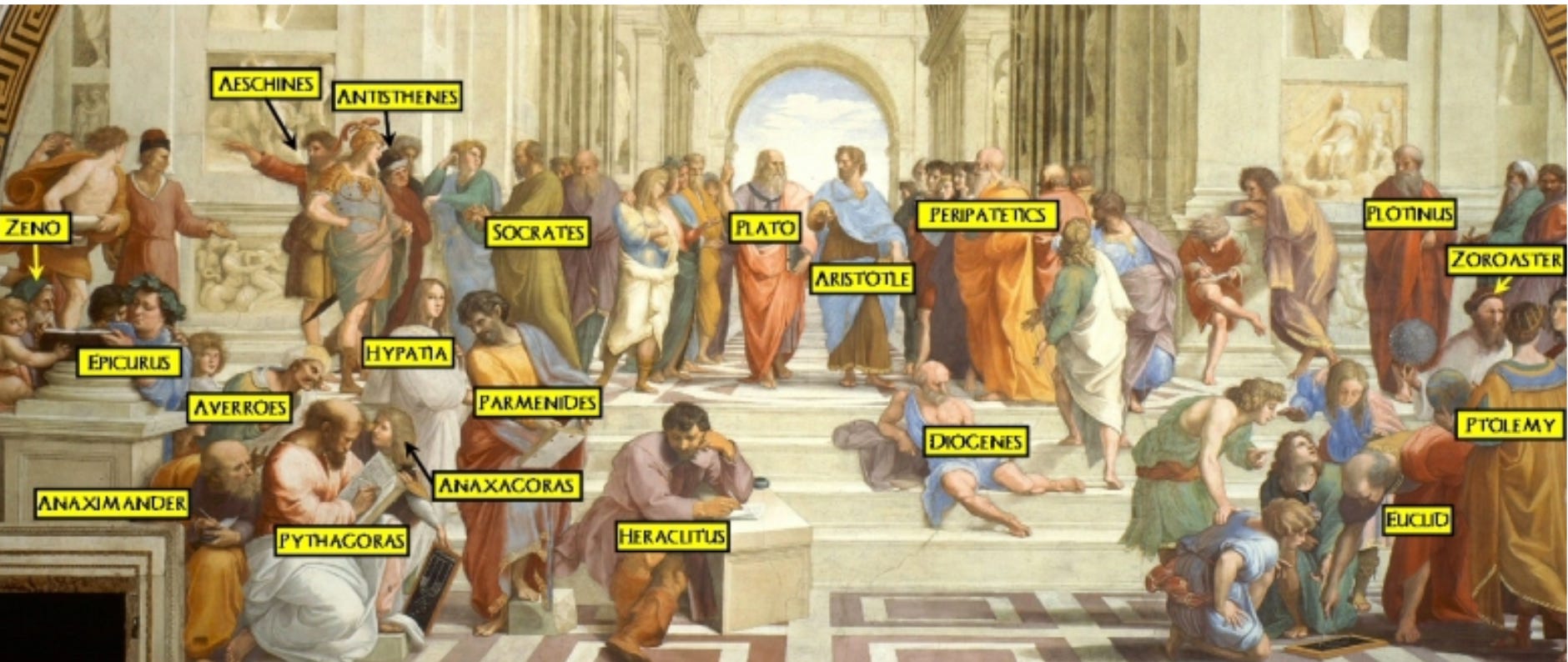
Both Christianity and Islam have been, at times, open and repressive, broadminded and fanatical. What matters isn’t the faith, but the society. The Christian Reconquista replaced Spain’s religious pluralism with persecution; Islam’s own golden age ended when rulers, facing instability, tightened orthodoxy and crushed inquiry. The madrasa system supplanted the House of Wisdom; inquiry gave way to rote learning; intellectuals and merchants were sidelined in favour of military officials and clerics. Norberg draws the same lesson from other civilisations: the moment a society closes itself to new ideas and starts to fear the ‘enemy within’ — out of fear, nationalism or elite capture — it‘s the beginning of the end. “Failure is not a fate but a choice,” he writes.
Norberg’s lesson is clear: when societies close themselves to new ideas, fear the “enemy within,” or let elites monopolize power, decline begins. Athens, Song China, Renaissance Italy — all show that progress is reversible, and failure is a choice.
Art’s great leap backwards
I thought about this standing under the Portico of Glory at the main gate of the Santiago cathedral. Even now, it’s magnificent: you can (and I did) stare at it ages, spellbound by its message and detail. It must have struck contemporary visitors as nothing short of divine.
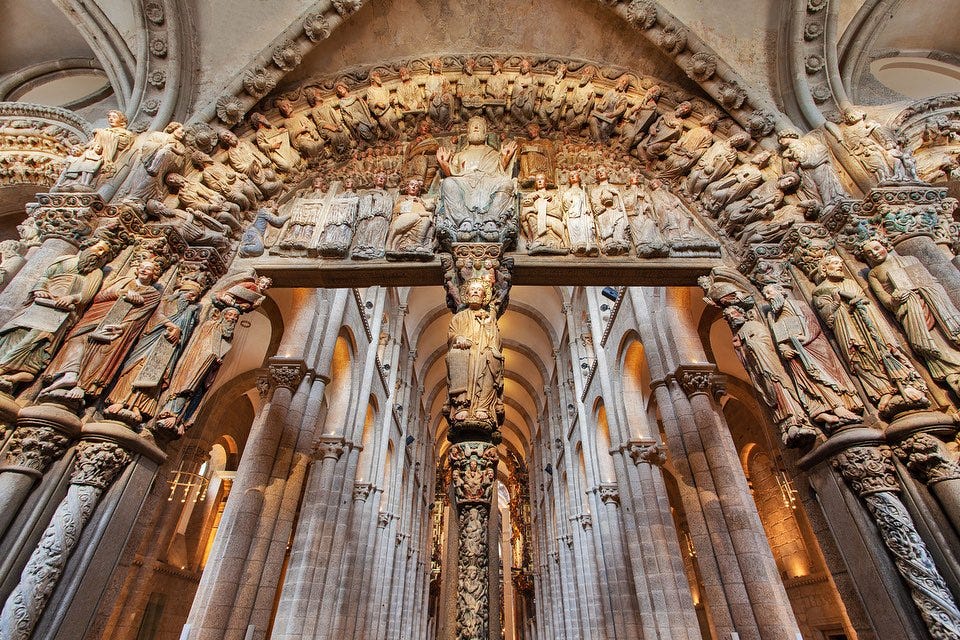
“What strikes me is how early on this was” said my friend Fredrik Erixon, with whom I made the journey: at 1210 AD, he’s certainly right. But I was standing next to him thinking the opposite. Those chiseled stone figures are nothing compared to the fluid marble sculptures of Phidias or the ancient Greek art that I spent so much time around as a teenager.
When my dad was posted to RAF Akrotiri, we lived near the ancient Kourion amphitheatre where my mum ran a music society. People would gather in that magnificent stadium and listen to classical music over sunset. Growing up there sometimes felt like having the antiquity as your playground. We’d regularly visit the temple of Apollo Hylates; my favourite, at the time, was the mosaic of Ovid’s Pyramus and Thisbe in Paphos (below) discovered in 1962. All of these wonders created a millennium before the Portico.
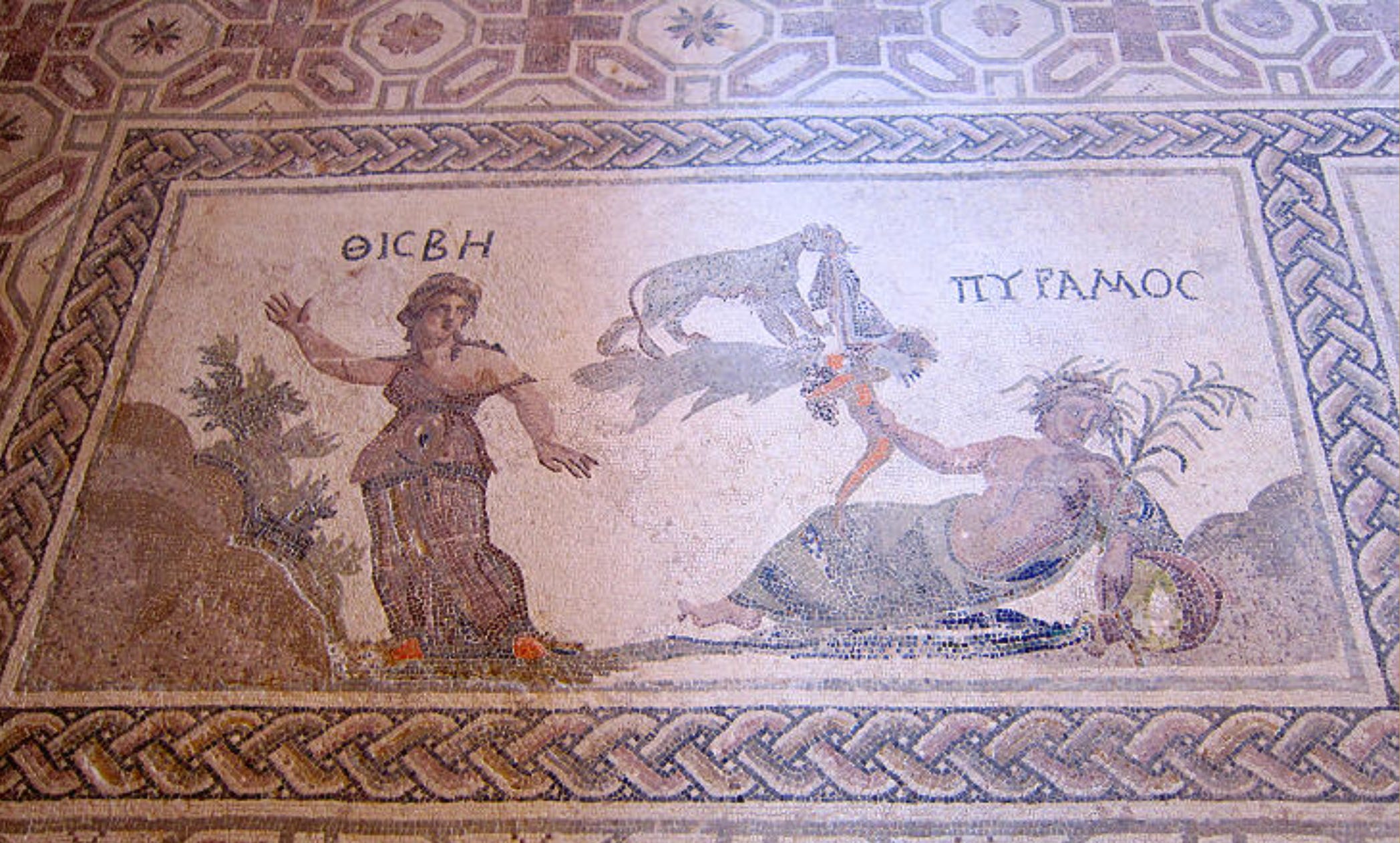
To admire any art in antiquity is to think: look at what we could once do - and lost! It’s one of the terrifying wonders of the world: how the knowledge and skill of making such culture and art, built over centuries, was wiped out. And not rediscovered for a millennium and more. The rise and fall of civilisations shows that mankind’s ability to learn and build is equalled by our ability to rush blindfold into our self-destruction. And we could absolutely do it again.
We are open - but then we suffer from altitude sickness. Something goes wrong. We panic. We turn in on ourselves. Here are Norberg’s lessons
10 ways that civilisations end
1. Elites stifle innovation. Once elevated by progress, elites often “kick away the ladder” by reimposing orthodoxies, resisting further change, and securing their own power at the cost of future innovation.
2. Crisis-Induced Reactionism. Crises (wars, pandemics, famines) often cause societies to retreat into rigidity and nostalgia. They abandon open intellectual inquiry and adopt rigid doctrines, often enforced by alliance of state and religion.
3. Centralisation and Authoritarianism. Power is centralised in response to threats (real or imagined) undermining the adaptive institutions that once made countries successful. (Late Roman emperors, Song China, Abbasid caliphs.)
4. Cultural Closure A shift from curiosity to control. Societies that thrived through openness to foreign ideas and internal experimentation begin to suppress dissent and enforce a single “correct” worldview.
5. Economic Controls and Debasement Governments resort to price controls, coinage debasement, and attacks on property rights to extract wealth. These actions distort markets and erode prosperity—e.g., Diocletian’s price edict in Rome.
6. Rejection of Global Trade. Isolationism replaces internationalism. Civilizations turn against the trade and migration that once nourished them, leading to economic and intellectual stagnation—as seen in Ming China and late Rome.
7. Loss of Cultural Self-Confidence. Societies shift from exploration to preservation, trading dynamism for safety. This mental transition mirrors Athens’ turn from openness to Sparta-like defensiveness.
8. Backlash Against Diversity and Globalisation. Declining civilizations often scapegoat immigrants and external influences, cutting themselves off from sources of renewal.
9. Decline in Rule of Law and Institutional Trust As rulers and elites consolidate control, legal norms erode, institutions weaken, and corruption rises—common in the late stages of most golden ages.
10. Fetishisation of health and safety. Fear and a desire for stability lead societies to reject unpredictability and risk—the very things that fuelled their ascent. Jonathan Sumption makes this case in his latest book.
What St Augustine should really have confessed to
One of the books I brought with me to read in Galicia was the Confessions of St Augustine. Norberg casts Augustine as a villain who should have written a follow-up: “Confessions: how I brought down the Roman Empire”. Here’s what he has to say:-
The first to fall was the empire of ideas. Under pressure from decline and invasions, the Roman mind shed its worldly, practical philosophy. No one was more important in this transition than the theologian Augustine of Hippo (354–430). Inspired by Plato and the neo-Platonist Plotinus, he developed an idea of an all-powerful God who judges our every thought. Augustine was the church father who developed the idea of original sin…In sharp contrast to the traditional pagan view, Augustine saw the individual as hopelessly weak and her senses clouded. To save souls, he advocated religious persecution. It was better with ‘short-lived fires of the furnace for the few’, so as not to ‘abandon all to the eternal fires of hell’… Therefore the Aristotelian curiosity about this world was nothing but a malady, ‘the lust of the eyes’, just as bad as the lust of the flesh. The potential for scientific and technological progress here on earth was removed from the intellectual vocabulary and would not return as a dominant theme in Europe for 800 years.
Jihadism: a European corruption of Islam?
Jihadism certainly is a threat now: to the West and, even more, to Muslim societies But this is a cancer in Islam, just as puritanism was to Christianity. There are open versions of Christianity, which we have now enjoyed in the UK for generations - and open versions of Islam. The German/Lebanese scholar Bassam Tibi has argued that the origins of jihadism - and its virulent antisemitism - lie not in Islam but in European totalitarianism.
To conflate jihadism with Islam is play into the hands of the Islamists - but that’s exactly what we risk doing now. The UK has Islamist nutters, but they are vastly outnumbered by Muslims who enjoy and defend the liberal, pluralistic and tolerant society we have quietly built. It is a stunning success, but one we will trash if we don’t recognise it.
I’m a Christian but would not describe the UK as a Christian country. As I’ve argued in The Times we’re a multi-faith society, guaranteed by tolerant, liberal consensus. Our nation was shaped not by any Middle Eastern or Arab religion but by the Magna Carta, the 1688 Glorious Revolution, the Anglo-Scottish Enlightenment, the 1832 Reform Act, by Cobden and Bright’s free trade, by Monty Python’s humour. Religion’s place is in the home, not the state. Adam Smith was writing in opposition to clericalism in a Scotland that came close to being a Presbyterian theocracy. The Scottish Enlightenment was a revolution supplanting the idea of top-down knowledge (doctrine) with bottom-up knowledge (empiricism). A manifesto for an open Britain - and for the modern world.
But to defend a winning formula, you need to recognise it. Norberg’s book is a much-needed tool to help us do so. To borrow his quote from Goethe: “you cannot inherit a tradition from your parents; you have to earn it.” We have inherited not a Christian, Muslim, or even secular civilisation, but an open one — and that openness is ours to renew or to squander.
There is no insularity. There is a very real Threat from Islamism to our way of life now, however it was shaped. Populism is a defence mechanism to an existential crisis. It’s a logical move. Whatever Islam was, the version that is represented in the west now is not contributory, it is destructive, tyrannical and controlling. To defend yourself against a bully does not make you a bully. It does not make you irrational. It is the strength you need to show to protect yourself, the ones you love and your way of life. Especially if the alternative that is being forced upon you against your will is misogynistic, homophobic and undemocratic. Any reasonable person accepts that cultural differences can be a benefit to forming an even better culture, but if one specific culture tries to impose itself on any other culture, to dominate and control, and to do so with violence, it must be resisted with everything you have at your disposal.
Look more closely. Civilisations don’t “Fall”- they evaporate. (A common misconception of Rome). They are, more often, “absorbed”, as the European West is now, swallowed by Islamic Reconquest. Accelerated by people- and idiotic Governments- not looking- more closely.