

Menzies Campbell, whose death has just been announced aged 84, was the last of the gentlemen politicians, one of the last of the true liberals. His short leadership of the Liberal Democrats was a rare moment where his anachronistic honesty, charm and idealism stood out in a parliament of chancers. The best people are seldom the best leaders, and I never worked out why Ming wanted to lead. I once interviewed him to find out and looked up my notes.
“I’m going to take my tie half-off,” he told me (it was the sweltering summer of 2007). “Feel free to do so.” A journalist is never worse-dressed than his interview subject, so he gave me permission to lower my tie knot by an inch or two. He removed his jacket; I did likewise. “There’s nothing else I can take off!” laughed his press officer, who was sitting beside me in a dress. Ming stuttered and blushed.
It was one of his many awkward interview moments. He liked spend weekends at home with Elspeth, his wife, so missed the weekend interview shows and the then-new era of rolling news. Aged 64, he had just succeeded Charles Kennedy whose career was ended by alcoholism. He told me that the Tories had signed up to Labour’s huge spending plans, leading to a new kind of “Butskellism” mind-meld. He was, tragically, quite right. He defined his beliefs as “freedom, ambition and compassion.” He said he felt especially strongly about ambition because he had - as he put it - lived four lives.
“I was fortunate enough to be an international Olympic athlete, fortunate enough to go to the Bar and take silk, fortunate enough to become an MP and then fortunate enough to become leader of the party. I want a country where that kind of opportunity is open to anyone willing to grasp it.” Of course, no one becomes an Olympic athlete by luck or accident. He possessed immense determination, which never seemed to weaken with age. Nor did he mention his fifth life: recovery from cancer after being diagnosed at 60. He made a complete recovery after chemotherapy, and encouraged by Elspeth, immediately returned to work. She died two years ago.
Ming called it “the Protestant work ethic.” But I always had my own theory: that pressure came from his family. His father-in-law was General Roy Urquhart (below), who led 1st Airborne Division in the 1944 battle to capture Arnhem bridge. It was part of a massive, audacious and failed attempt to follow up D-Day by crossing the Rhine and ending the war early.
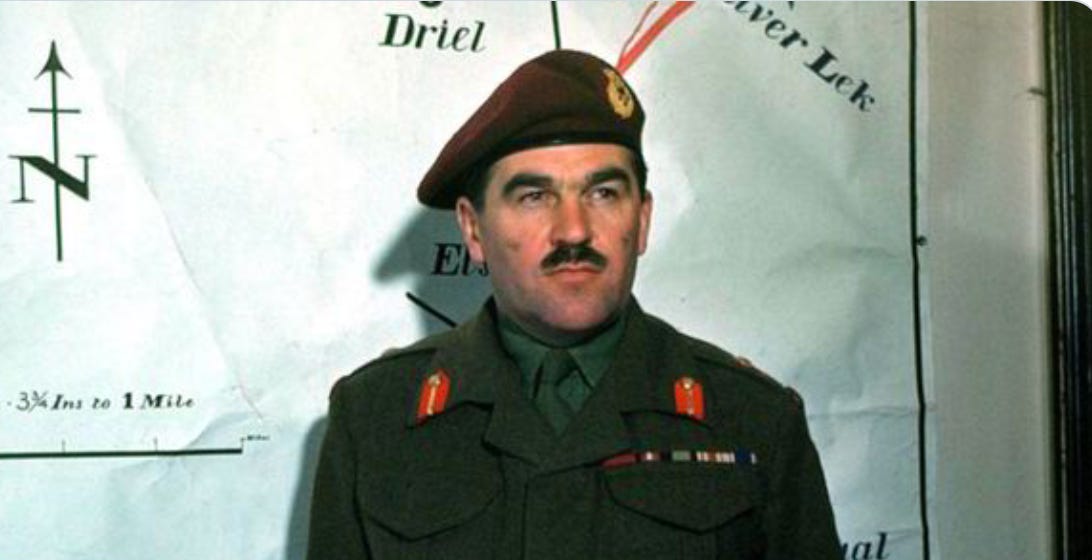
Arnhem was too well-defended and Urquhart’s team were doomed. But he became famous for his steady leadership under impossible circumstances. He was played by Sean Connery in A Bridge Too Far. A national hero. Ming married his daughter.
So when I asked Ming if he measured his achievements against his father-in-law, I was taking a guess. I expected a blank stare. Instead he had an answer ready. “I’m not competing with him,” he shot back. I felt that I’d touched a nerve. I suspected that a part of him, in truth, was measuring himself against this impossibly accomplished war hero. Perhaps, leading the LibDems was Campbell’s Arnhem. His ‘bridge too far’.
But in many ways, Ming had already achieved the impossible. For a while, he was the fastest white man in the world (in action, below) running the 100m in 10.2s. The world record at the time was 10s. He captained the UK Olympic Athletics team in 1967 and 1968 while studying for the Scottish Bar. This was another age: when Olympic athletes were top scholars who trained in between their legal studies.
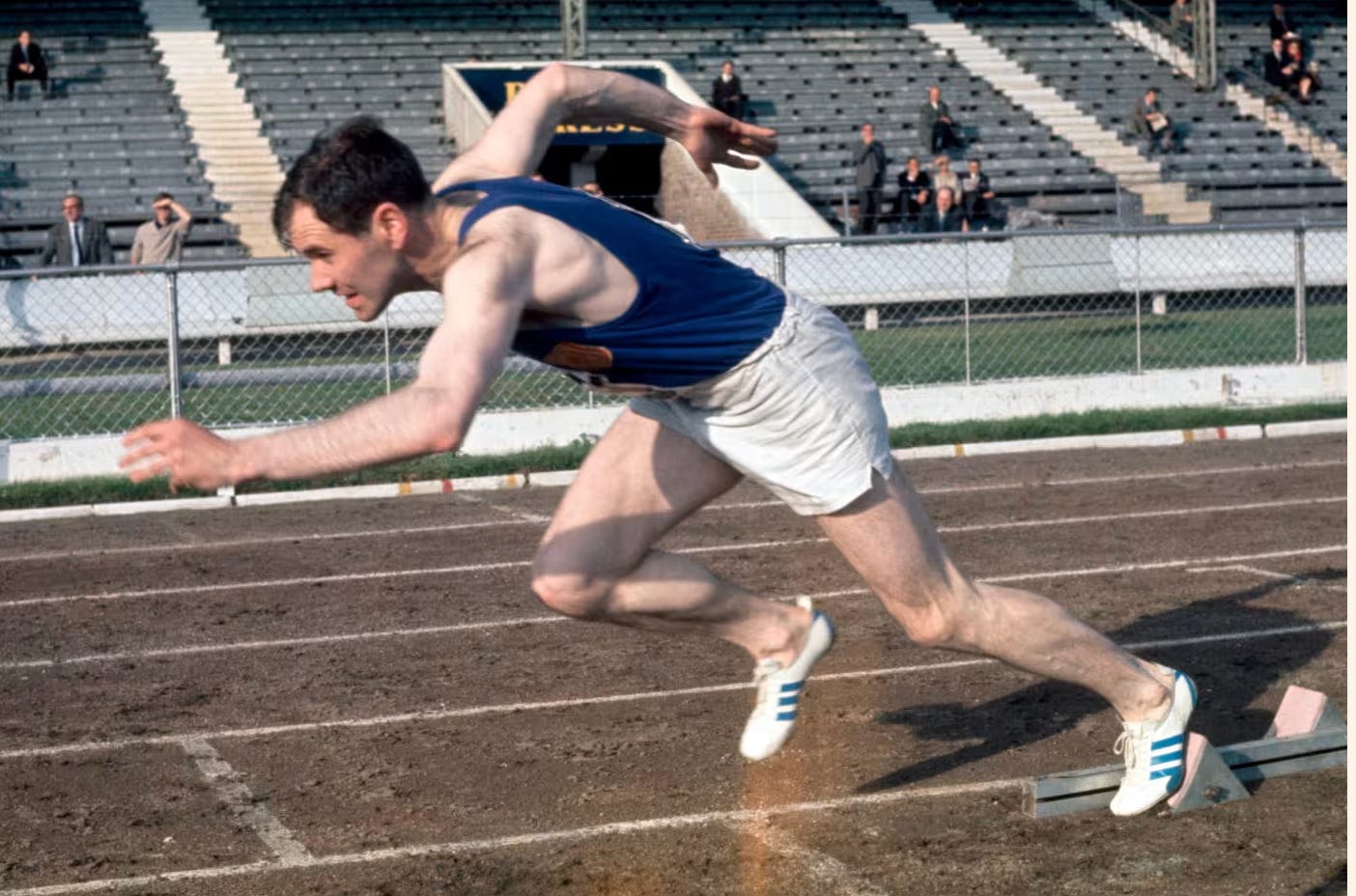
But I’d heard that his family was unmoved by his heroic achievements, which baffled me. And I wondered if that had in some way given him drive. So in the interview I asked how his parents reacted to his selection for the British Olympic team. He answered in an instant.
“It was: ‘well done, what would you like for tea?’ That’s a huge thing in one’s life and I remember it so clearly. For them, my sport, my going to university and getting two degrees, they saw all that as a natural progression. It’s a very Scottish thing. I’m fairly certain I don’t need to tell you.”
We were both Scots. But in my corner of the Highlands being picked for the egg-and-spoon race was a cause for family celebration, never mind the 18th Olympiad. “Well, my parents were ambitious for me. No question about it. But insofar as these were achievements,” - he was referring to holding the British 100m record for seven years - “no great fuss was made of them. They were the expected reward for the effort you were assumed to put in.”
Campbell, a QC before entering parliament, made no great fuss of himself. But this is not always a political virtue in our ego-obsessed culture. When I last saw him, his secretary was wrapping a book that had been bought as a parting gift for an intern. She asked him to inscribe it, but instead he signed a separate slip of paper and tucked it inside. He didn’t want to spoil the title page. “Signing it is the whole point,” she scolded. “Then she can sell it on eBay.” He looked at her uncomprehendingly.
I was in the chamber for Ming’s first-ever PMQs, when he asked a question about school pupils being left in the lurch because they had no permanent head teacher. He must have been the only man in the chamber not to see the trap. At the time, the LibDems had no permanent leader - Ming was a stand-in - and the analogy brought the House down. MPs of all parties roared with laughter - more derisive joy - and pointed at the LibDems. I’ll never forget the sound, how it echoed; the bear-pit effect. Or Ming’s face: he looked around, baffled, as every finger in the House seemed to wave at him. He was making a serious point: what about these schools? And their pupils? Why are they all laughing? He just didn’t get the joke.
Here was a man of old-school character and principle, leading a party in a digital age of fake celebrity and meme politics where positions change by the hour. He never quite belonged in the theatre of modern politics, but perhaps that was his greatest virtue. Menzies Campbell did not bluff, did not bluster, did not fake. He spoke carefully, dressed properly, lived dutifully and carried himself with an integrity that now seems from another age. It did not make him a great party leader, but it did make him a great public servant. In his gentleness, his ambition and decency, he embodied the kind of politician we once took for granted - and sorely miss now.
What a lovely obituary for an exemplary human being.
Thank you for this, Fraser.
A tribute packed with revealing detail and insight.