
Most non-Catholics will be vaguely aware of a Papal visit to France right now. For Catholics, the scenes have been electrifying - all the more so because of the signs of vitality they show in a France where the faith had been assumed to be dying out. Standing in front of the Notre Dame, magnificently restored from a smouldering ruin after the fire just a few years ago, Pope Leo seemed to be moved to tears when he heard the crowd singing Salve Regina, a ten-century-old chant devoted to Our Lady. Here’s the clip:
This video has been going viral worldwide (amongst Catholics like me anyway) along with others like this one of priests hearing confession on street corners. I’m not sure that I’ve seen such scenes in any previous papal visit.
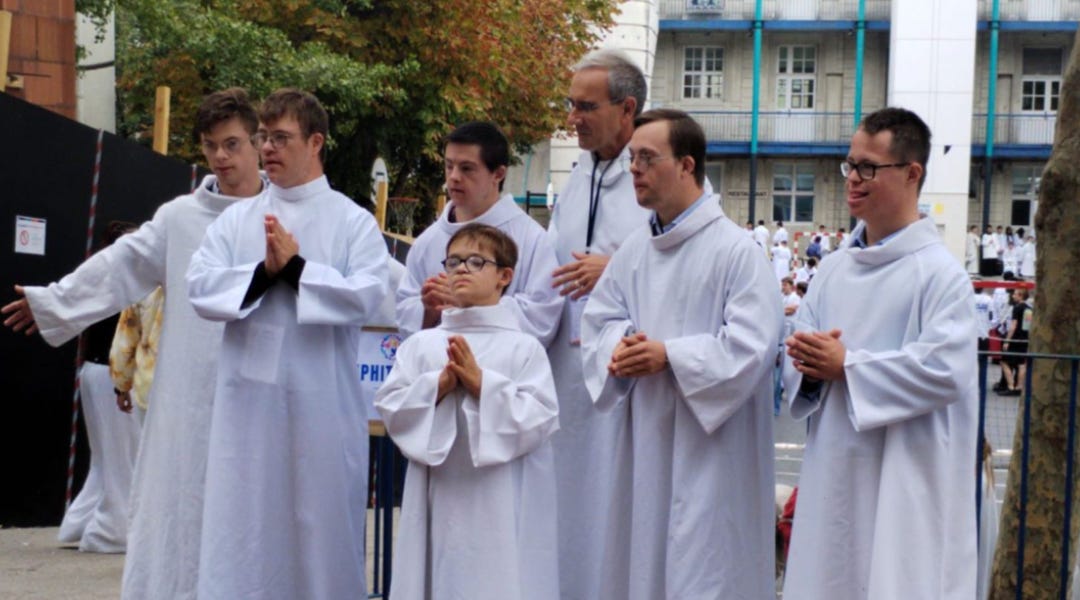
When the Pope said Mass in Paris it was watched by a million people. Six of the altar servers helping him at the altar had Down’s Syndrome. I found the picture of them together so beautiful as to bring a tear to my eye.
There was also a huge Stade de France event with 80,000 predominantly young Catholics also joining in the Salve Regina - unaccompanied at first. But on the last line the organ, strings and drums progressively joining for a mesmerising crescendo (from 1’15 below). Again, beautiful.
What an amazing effect: starting with these young Catholics singing in Latin, as if in act of mass rebellion against a digitised world. Which is the point. The Vatican knows that pictures and videos are now what communicates faith (a lesson that the newish Archbishop of Canterbury is learning the hard way) and the quality of the Paris coverage has been extraordinary. For all of its Christian architecture, France is by some measures the most secular country in Europe so you might have expected Leo’s visit to fall flat. Instead, it has been a phenomenon.
And that song. In a lifetime of going to Mass I’d never heard the Salve Regina until a few years ago; now I hear it everywhere. The first time, I had no idea what was happening. The priest had finished Mass and was walking down the aisle but stopped, turned to the statue of Our Lady and started. “Salve, Regina, mater misericordiae. Vita, dulcedo et spes nostra salve…” Hail Holy Queen, Mother of Mercy, to thee do we cry... About a fifth of the congregation joined in, my 83-year-old mum amongst them. It’s a pre-1969 hymn, she told me: what they’d sing after Low Mass - before the Great Leap Forward of the Second Vatican Council which modernised everything.
Her generation thought this an exciting step where the old world of incomprehensible Latin was banished forever. But the young, now, seem to love the old ways. We see the new trend of ‘rad trads’ - young radical traditionalists. In my own church, I see young women wearing mantillas. Now, I seem to hear Salve Regina all the time. My chr
It always had a kind of samizdat edge to it: a blast of forbidden Latin. It’s hard to explain the politics of Latin Mass to non-Catholics, as it sounds even madder than normal: but Latin is seen by some (like Pope Francis) as stuffy, elitist and exclusionary. It turns out that today’s young seek it precisely because it’s not modern but instead mystical and, in a globalised world, oddly unifying. The greatest contrast you can imagine to the dopamine-doling world of social media that so many young people are trying to escape.
I was at a Swedish-and-Latin Mass in Stockholm last weekend. It was a heavily immigrant congregation (no Swedes seem to be Catholic) with Polish and Ethiopian as the big two communities. All of us had ropey Swedish. But at the end of the service, everyone sang Salve Regina. “The most beautiful song in the world,” said the priest.
Perhaps this is why Salve Regina has become a kind of Catholic viral hit, cutting across all language barriers. Chesterton once wrote about the cycle of belief: when you think it’s dying out, the sons and daughters come to relish the faith their parents had been slack about. Such a revival can seem illogical and ahistorical to most people, he wrote, “like a river turning backwards from the sea and trying to climb back into the mountains”. The scenes in Paris suggest that a new current certainly is flowing. Pope Leo can sense it and wants to encourage it, in a way his predecessor didn’t.
My own church was so full this morning that crowds spilled out on to the street. It was the last Mass said by Fr Stephen Langridge, who is leaving after 11 years. The movement he built - with its youth ministry, the Alpha course and the slew of adult baptisms - is of a piece with the energy Pope Leo tapped in Paris. Perhaps the river is not turning backwards after all, but finding its old course again.
I’m not a Catholic but I think Pope Leo is doing great things and became Pope at the right time. The world needs him.
Great post, Fraser. Very inspiring to see the Pope singing in front of the magnificently restored Notre Dame. As a fellow parishioner of St Elizabeth's I can testify to the remarkable work Fr Stephen Langridge has done. What I love about the Salve Regina is that it acknowledges that the world is full of suffering and pain '...mourning and weeping in this vale of tears ...' but also that there is hope '... our life, our sweetness and our hope...' and that we have some responsibility to live up to that hope '...that we may be made worthy of the promises of Christ.' An excellent prayer for when the news just seems impossibly depressing. Yes, there is evil in the world; no, it isn't the last word; and you can (need) to do whatever you can to build up the good.