Reform’s Zia Yusuf problem
Can Nigel Farage control his policy chief?

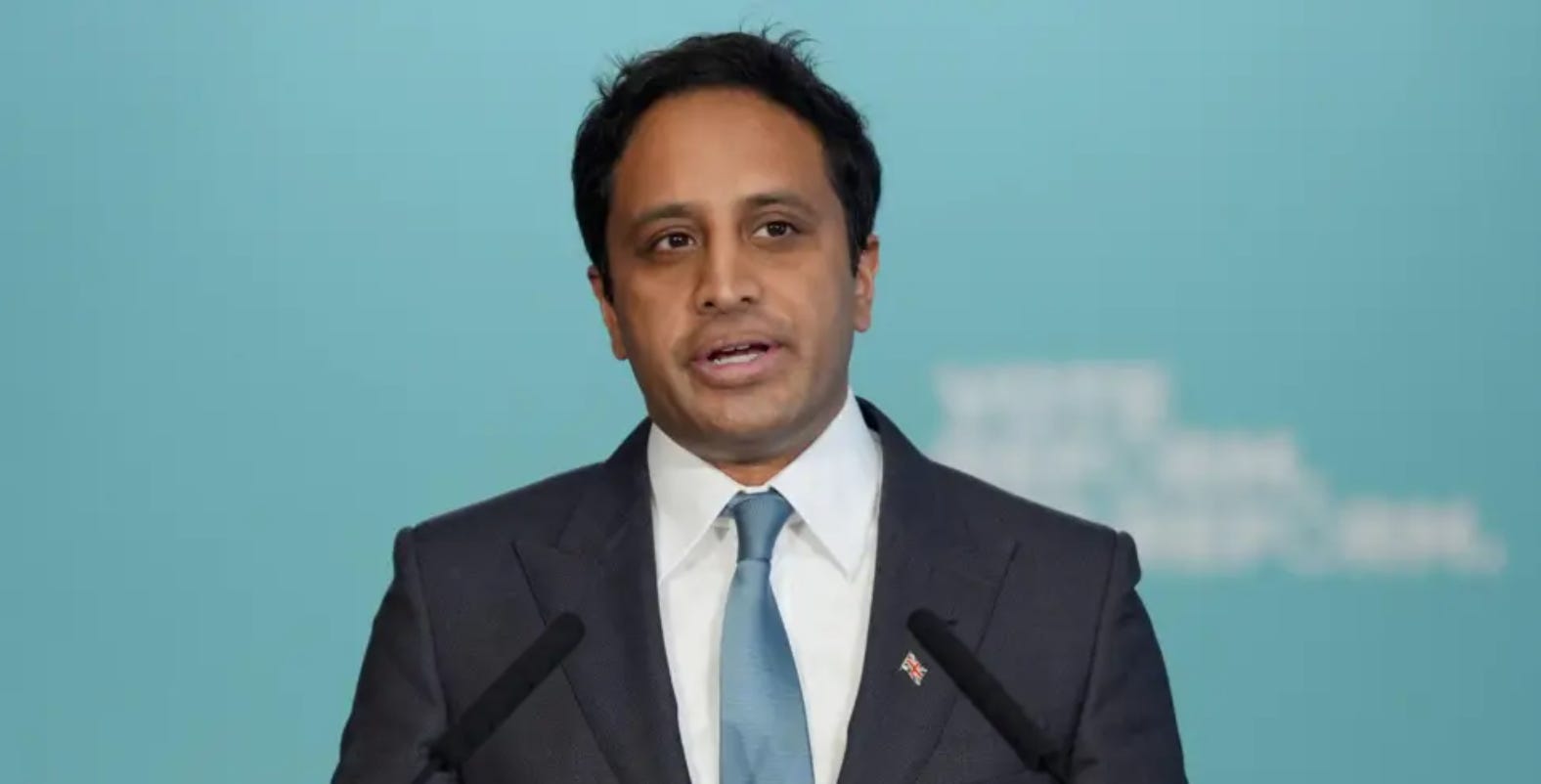
Throughout his long political career and many parties, Nigel Farage has tended to steer clear of the type of politics that Reform UK has now ended up pushing. The great vibe-shift, after Trump’s re-election, was a time for experimentation. If old taboos have gone, if social media has replaced the press as a mediator of political conversation, then how far is too far? Once, this was be Farage’s speciality: recognising and policing the boundary that separated his outfits from the unelectable hard right. But his parties, then, were all his: a one-man band. Reform UK is a far greater operation with more people. And he finds himself tugged towards the extremes by two centrifugal forces: social media and Zia Yusuf.
His policy chief is a man of undoubted achievement and eloquence, a strong broadcast performer in spite of having no previous experience in front of microphones. I disagree with most of his views but I’ll say of him what he’d never say of his opponents: he’s intelligent, accomplished and energetic. The question is whether he is now putting those talents in the service of a destructive agenda which in my view is now starting to toxify Reform UK - crossing the line from muscular to rabid.
A few example:
‘Traitors’. He presents Reform UK as the only legitimate voice of ‘the people’ and its opponents as enemies of the people, even traitors. A classic authoritarian position. He has made no secret of his dismay over the arrival of former Tories (which, oddly, he was until 2024).
Mass deportation. He has overcome Farage’s objections to mass deportation and committed Reform UK to tracking down and deporting every single undocumented migrant. Two million, he says, if need be. “You’d better believe it.”
“Trump mark two”. Such deportation would need a massive police squad and a British version of ICE - which he actively welcomes. “It’ll be much more like Trump mark two than Trump mark one,” he told The Times.
Domestic enemies He proposes to build detention camps for migrants in the constituencies of people who did not vote for Reform UK, especially in Green seats. This sets up a notion of internal conflict. Until now, politicians of all parties have said they will, if elected, serve supporters and critics equally. Yusuf is revelling in the idea of detention centres meted out as a kind of punishment to be meted out to Brits who reject his politics. He seems to regard quite a lot of his countrymen as his enemy.
Personal hostility as a signature style. Yusuf sees political civility as weakness; deplorable cosiness. He boasts that he never spends time in TV green rooms talking to opponents before debating them. The usual ethos of democratic civility - disagreeing with opponents but respecting their motives - is one he actively, loudly and regularly rejects.
Islam. Oddly for a practising Muslim, he can talk about Islam as if it’s a threat to Britishness and proposes to ban disused churches from being used as mosques. This hardly ever happens, but such policy is intended to reinforce an Islam-vs-Christianity narrative.
Sikhism. He proposes making the UK one of the few democracies in the world to ban the kirpan, a ceremonial knife worn by initiated Sikhs. You can argue that banning the burka for Muslims is more about dress than faith, but banning the kirpan is a direct infringement of religious liberty. The risk is that the Jews start to see a patten, and wonder who might be next. As is is already happening in America and with Restore UK, which is already gunning for kosher food.
So many of the above now seem like signature Reform themes that it’s hard to distinguish between the party and the Yusuf machine. But this is becoming the problem.
It was brought to a head by Yusuf’s reaction to Ben Wallace yesterday. Calling a Tory a ‘traitor’ is hallmark Yusuf, but he chose the wrong target with the former Defence Secretary. Before politics, Wallace was a Captain in the Scots Guards and was mentioned in dispatches while deployed in Northern Ireland. Yusuf made his money selling jaunts to plutocrats - taking them fighting with ninjas in Japan or tracking snow leopards. All through a company he ended up selling for £250 million. Good for him. His segue from billionaires’ gofer to a denouncer of elites has been a bit rich. But to accuse a veteran and former Defence Secretary of being a traitor is too much even for Reform members.
Tim Montgomerie, one of Reform UK’s higher-profile signings, says he has raised this issue privately and repeatedly with Farage and Yusuf. He has now gone public with his criticism.


“Opponents are opponents... they aren’t enemies... or ‘morons’. One of the biggest question marks over Nigel Farage’s leadership is whether he brings Zia under control.” Yusuf, he says, “is a man of huge talents but too much of his social media output is intemperate and reinforces Reform’s number one problem: our negative tactical voting challenge.”
The tactical voting is the issue: Reform has moved so far to the authoritarian end of the spectrum (it’s not a move to the right) that there are people on the right, left and centre now united in their main political desire: to vote for whoever, locally, will stop Reform. They’d rather see Andy Burnham in No 10 than someone like Yusuf in the Home Office.
Montgomerie’s post says what a lot of Reform supporters think: that Yusuf, for all his eloquence and talents, now looks out of control. And is starting to damage a party that needs to build alliances if it stands any chance of power. Some Tories even joke that Yusuf (a former Tory member) is a sleeper agent. So why doesn’t Farage take action?
Some argue that Yusuf was one of Farage’s original sugar-daddy donors, getting in there before the crypto kings and that he has a hold over Farage that puts him beyond discipline. I think it’s something else: Yusuf is very popular with the party’s membership. His framing - ‘we speak for the people, they’re all traitors’ - fits with how Reform’s most dedicated members see themselves. Lord Ashcroft is the only pollster to have gauged opinion on who members would most like to see succeed Farage, and found Yusuf clearly above Richard Tice and (a far less popular choice) Jenrick. Perhaps Yusuf is preparing for exactly this contest.
But how is Farage supposed to lead the party? Is Reform for or against mass deportation? Farage thinks against. This was one of the points of departure for Rupert Lowe, whose Restore party has now run with the ethnonationalist ideas cooked up on Reform’s fringes. The Daily Telegraph is now going hard after Lowe for his ambiguity over whether the King, being born to a Greek father, is White British - and it’s a significant campaign. This bizarre, toxic theory - that White British people will be in the minority by 2063 - was launched last summer by Matthew Goodwin, a GB News presenter and Reform by-election candidate. He cooked up the 2063 figure by assuming no child or grandchild of a migrant can or would want to classify themselves as White British, and by disregarding the well-documented trend of migrant birth rates converging on the mean. At the time, it was ignored as a weird, fringe figure - but the firepower the Telegraph is now devoting to it makes clear where it draws the line. And Allister Heath is explicit: Reform needs to be on the right side of that line, rather than maintain an ambiguous position on ethnonationalism.
During the Makerfield by-election, Reform responded to the rise of Restore by adopting racial politics, presenting whites as victims of UK government policy. Jenrick even ended up advocating the death penalty. This served only to harden strategic votes against Reform - Tories said the rejected racial grievance politics of the woke left and the ‘woke right’. This is what happens when you go over a line. It’s not about caustic editorials in newspapers: it’s about voters deciding that their number one priority in an election is to stop you.
Would Yusuf’s detention-camp plan to deport up to 2m work? Of course not. But would you want to live in a country where he is Home Secretary, trying to implement Trump mark two? If not, then you vote for whoever is most likely in your constituency to stop Reform. This is already starting to happen, and it is depriving Farage of his most powerful weapon: the idea that he stands a serious chance of taking power at the next election.
Farage has discovered where the pale lies in British politics, and is discovering what happens to parties who move beyond it. Either he reins in Yusuf - or decides, if his policy chief cannot be dialled down, whether to part company with him entirely. Yusuf is prone to resignation: he quit as party chairman in a huff, then quit as head of Reform’s DOGE unit when it became clear it would not deliver the savings promised. It’s conceivable that he quits again.
But if he doesn’t - and keeps up his social media campaign denouncing people like Ben Wallace as ‘traitors’ - then Farage will have to end his strategic ambiguity and do something.
Farage has spent decades testing the limits of British politics, but he has also understood those limits rather better than most. Yusuf represents one possible future for Reform: furious, uncompromising and convinced that moderation is betrayal. All of this can generate high online engagement and loyalty: bread and circuses for the party faithful. But it can also generate something more powerful still: a coalition of voters determined to stop you.
“I'm not going to get dragged down the route of mass deportations or anything like that,” said Farage in Sep24. “If I say I support mass deportations, that's all anybody will talk about for the next 20 years. So it's pointless even going there.” But he was, in the end, dragged down that route - and Yusuf did the dragging. The question now is whether he can make his way back, or whether Reform slowly perishes where it is.
And what makes me so confident that Farage does not share Yusuf’s politics? He’s been on the political scene longer than any other leader, his thoughts and policies on the record more than any other. I even spent a time undercover, turning up to hear him speak in village halls to see if he’d dog-whistle on
Farage’s great achievement was to make Reform look not merely like his latest protest project but the most likely next UK government. His own crypto-money scandal has dented this momentum. But if he can overcome this and recover his recent achievement, he will have to get back to doing what he used to do best: drawing and policing boundaries. And making clear to Yusuf where those boundaries lie.
UPDATE Farage says ‘traitor’ was ‘too strong a word’ that he will give Yusuf a ‘ticking off’. Let’s see how that goes…
Strong piece Fraser. But although Reform’s rise is troubling, being old, as I am, gives one the advantage of a real historical perspective. I lived in Coventry in the early 60s when the BNP was also rising and fast. It targeted working class areas where immigrants, mainly Pakistani, were settling in large numbers. True, the media was less wildfire swift in spreading news and social media did not exist but although there was certainly hostility in general the local citizens learned by experience that their neighbours were just that. They worked extraordinarily hard and mainly they prospered. In general, the first generations did not integrate. They kept their own languages and customs and looked inwards, clinging to what they knew. But things changed as children and grandchildren and on, went to school and then work in the community in which they were born. The problems were often health ones. TB which was close to being eradicated spread again, largely because of families packed together in close quarters. I had a GP friend who worked largely among that community and he often despaired, yet knew that time, integration and prosperity would solve many initial medical problems like this. The blood running down our streets which Enoch Powell predicted did not run. The BNP failed and faded. There were always bully boys trying to start trouble and sometimes they succeeded. Some immigrants never integrated because they did not want to. But overwhelmingly most did. I have daily talked to local shopkeepers and others who are their grandchildren grown up and as British as I am and regard the early generations with some sadness for the hardships they endured, not to mention the hostility, but also with the view that they were history, that was then. Let us hope so. But I am optimistic. Old age does have its benefits
To Mark B & W Hagerup…you are missing FN’s main point.
Farage has been brilliant at hiding the iron fists in tweed gloves.
Yusuf has torn those off & may be preaching successfully to you guys in the choir…but every time he drags Reform Rupert Lowe’s way he hardens the resolve of the rest of us (which is still the majority BY FAR) to do WHATEVER it takes to stop such would be authoritarians.
Driver Andy