
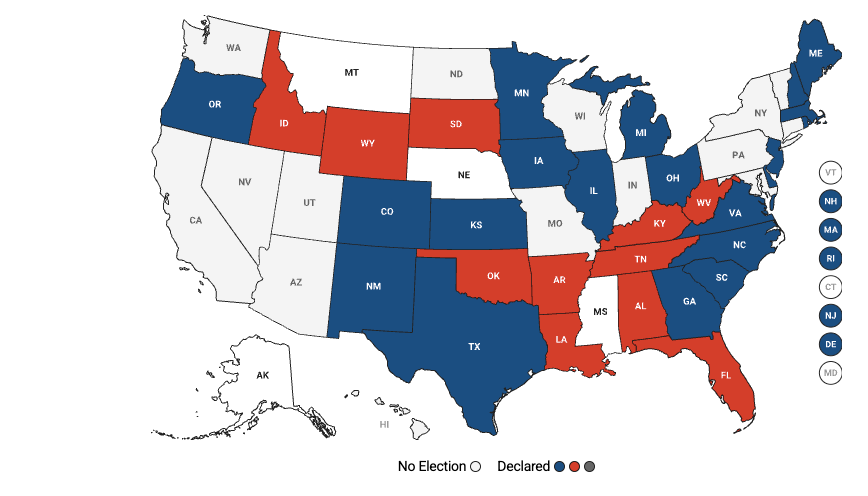
Donald Trump asked Americans to vote as if his name was on the ballot paper - and they duly obliged. The result is what Barack Obama, in his mid-term setback, called a ‘shellacking’ - a caustic rebuke for failure to convert promises into results. “Inflation is solved,” Trump said yesterday. “Everything is going good.” Voters begged to differ. Democrats have won the House and Senate. Some projections suggest 260 Democrats in the House, the largest caucus for any party since 1990.
There’s so much to unpack in these elections, each with their own story. James Talarico’s stunning victory in Texas was explained a week ago by Katy Balls’ profile of the man, his state and its direction. The results in Texas and in North and South Carolina are in no small part due to Trump backing loyalist candidates with weaker voter appeal in a belief that his personal benediction would be the magic factor. As I write it looks like Scott Collumn may be the first Democrat to take Mississippi for 44 years. So what’s up?
But what the exit polls suggest, as The Sun would say, is that it was the cost of living wot done it. The below shows a poll of 80,000 voters. Trump stood for office saying he’d act on living costs, just as Andy Burnham positions himself as the man who will deliver ‘breathing space’ and bring hope. Both men have the power to act, neither has anyone else to blame given their control over the political system. And yes, politically, the two men could scarcely be more different. But both made a direct, retail appeal to voters: we know times are tough and we will help you out.
American voters remembered it. About nine in ten said the cost of living was a crucial or major factor in their thinking on how to vote for Congress. Three in five blamed Trump for higher prices rising to 96pc of those voting for Democratic House candidates.
And what troubles Brits today? The economy, on which Burnham emerged from last week’s Budget with nothing to offer. Immigration, which his Home Secretary is getting under control. Defence, where he has dangled more funding but has no idea how he’ll deliver. Health, where the waiting lists are rising again. And welfare where - well, we’ll see after the Milburn review. Burnham’s theme so far is “breathing space” living costs, just as Keir Starmer promised growth and Trump to control prices. The below shows (in blue) how it was forecast under the last Tory budget and (in red) forecasts now. I’ve done the chart in cumulative, not just year-to-year, to show the sustained impact of UK inflation.
In America, inflation predictions are almost an article of political faith. Republican voters believed Trump in saying it would fall; Democrat voters did not. The below chart, a Michigan Uni survey, shows this fascinating divergence. And the Republicans who did place Trust in Trump to control cost of living now know - in the surging fuel prices - that this was not to be.
A few other observations:-
Trump’s voter coalition unwinds. The book that predicted Trump was Party of the People by Patrick Ruffini, showing how, even before his second-term nomination, black and Hispanic voters had been coming over to the GOP to form a working-class coalition. They saw Trump as a crude but necessary tool for fixing problems unleashed by Biden’s collapse of border control and inflation. The unravelling of that coalition (shown in early results) is striking. Voters are more prone than ever to lending support to whoever they think will do what’s necessary. To wit…
The sultans of swing Some of the US swings are pretty wild and, again, it’s a theme we have seen in the UK. First, some American states from the results so far..
And in Britain we have seen similar swings…
Rise, Jon Ossoff. The post quasi-presidential speech came from Jon Ossoff, 39, re-elected in Georgia, a state Trump carried two years ago. Cue comparisons with Obama (who calls him Kennedy-esque) and talk of the White House in 2028 (esp from AOC sceptics). He’s a centrist with populist rhetoric. His pitch is that Trump promised to take on the elites, then set about enriching them. “And while the crook president and his crook family rake in billions from all over the world, you pay more for everything,” etc. Plenty of talk of “Prince Don” and “Prince Eric” in the Mar-a-Lago mafia. Ossoff combines mainstream Democratic policies with firey attack on grift and privilege.
The sleaze backlash. The Ossoff victory makes a broader and important point. Earlier this year I wrote in The Times that Nigel Farage’s crypto greed was in a Berlusconi-style format where a populist leader openly enriches himself and his base don’t mind. In the midterms, we see Americans mind about the way Trump and his family have enriched themselves while in office. The sense of shame was falling from politics, I wrote. But a sense of voter disgust, it seems, is not. Some 88pc of Americans mention corruption as their a concern when it was an option in a Fox News poll. Farage himself has never recovered from the disclosure about his secret £5m crypto gift.
Nigel Farage and the limitations of money Nigel Farage was assuring GB News viewers last night not to believe the “consensus that Trump is going to get absolutely smashed”. Why? “Political science. Get out the vote campaign. Data,” he said. “Elon Musk hasn’t chucked in $450m of his own money just for fun.” Republicans raised $3 for every $2 raised by Democrats - were still gubbed. Farage’s faith in the power of money to buy elections (and presumably in the power of his own crypto kings) led him to predict that “we’re in for a big surprise tonight.” So we were: the surprise being the size of the anti-Trump reaction and disgust at his style of politics.
Tackling immigration reduces support for anti-migration parties. Trump pretty much ended illegal crossings on the Mexican border (above), and the result was fewer Americans concerned about immigration.
As a problem is solved, its salience drops. Ironically, the Swedish conservatives found the same - their support rose but that for the Sweden Democrats, their ‘new right’ partner, went down. Meaning the bloc (just) lost power (although coalition talks continue). The UK is well on its way to border control, forcing Reform UK into the trickier ground of racial politics and who is already here.
Implications for 2028 This anti-Trump vote will dent shares in JD Vance. Ossoff says he’s not running for president but no one commissions a video like this unless they are. I suspect his victory will lead to a lot of pressure on him to save the Dems from AOC and left-populism, as the great rats-in-a-sack battle begins in DC. It’s looking a bit better for Rubio’s nomination chances; even De Santis’s chances come back from the dead. The vibe is shifting back.
America’s election results contain so many trends, you can pore over them for weeks. But the one that strikes me this morning is voters’ willingness to move, to ‘flip’ states or seats, to punish whoever does not deliver and try out who they think might. As Andy Burnham slowly gives up on the 2020s and talks about a ten-year plan, he ought to be alarmed about all this. Voters want action now. And if results don’t emerge, they have never been more willing to try - or even go back to - the other guys.
Not sure how simply creating lots more legal pathways for migration into the UK counts as border control…
Why can nobody admit or accept, politicians and voters alike, that the size of the problem exceeds the aggregate of the available solutions. I never hear the words “paradigm shift” anymore. Denial, they say, is not a river in Egypt. Voting Democrat, like voting Labour, will resolve nothing without broad based acknowledgment that nobody has Lilly the Pink’s medicinal compound equivalent for an easy way out.