The Tories return to welfare
This isn't about shirkers - it's about a corrupt economic architecture.

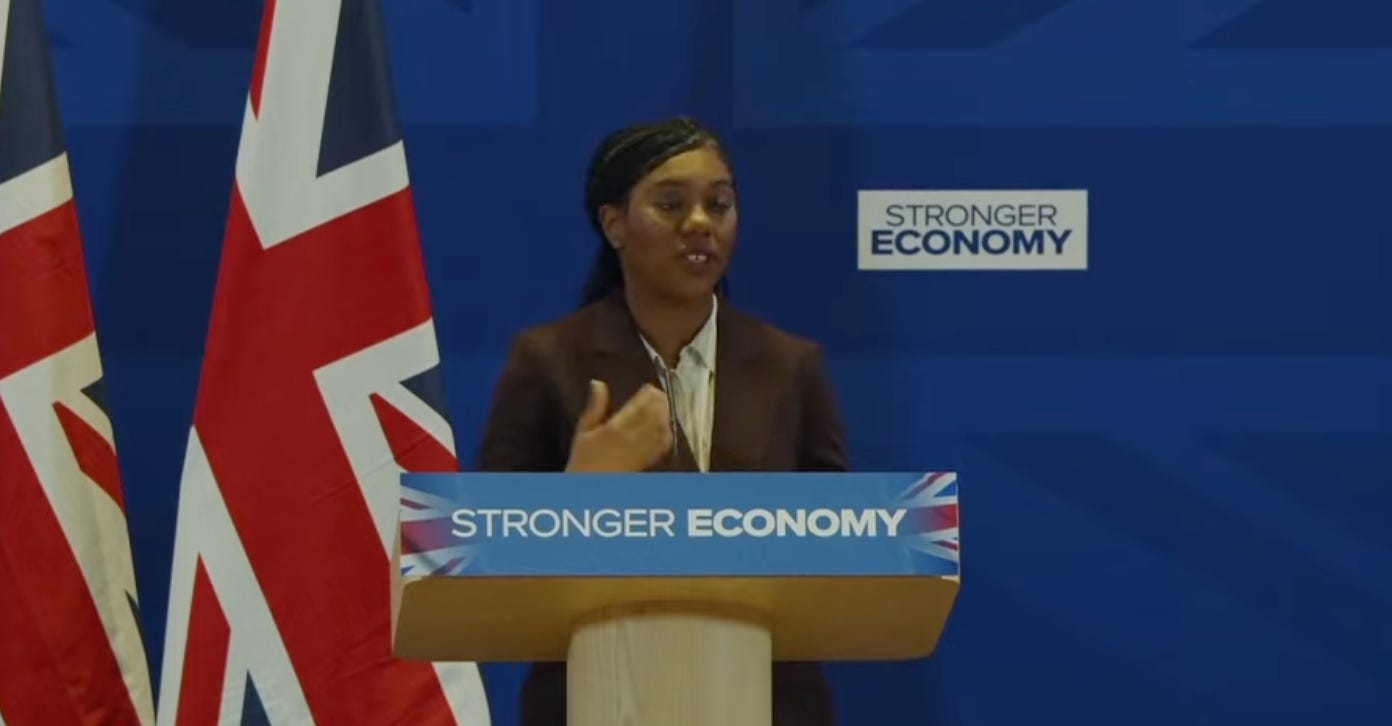
Welfare is in crisis - but it’s one that Labour inherited. It is in my view, it’s the most important question in UK politics and the Tories and at least we now have debate. But can it evolve beyond the cartoon caricature of workers vs shirkers?
Both Reform and the Tories wish to present themselves as the party of the workers, who share values with the ‘alarm clock’ people (c. Lee Anderson) or the ‘strivers’ (c. most Tories). The facile next step is to draw a moral dividing line and start to attack as skivers, scroungers or workshy those who are drawing benefits. Attempts to do this look right past the problem.
Kemi Badenoch today used her life story to express her values, and powerfully so. Starmer and Farage are both private-school alumnus: she arrived as an immigrant, flipped burgers for McDonalds then folded clothes for New Look. She’ll have hated that viral video of her, mocking her up as south London rapper, because that’s far from her self-definition. But it captured something about her: she is fundamentally an outsider, using direct language in a political culture that shies away from hard truths. At a time when people are fed up with politics-as-usual, the ‘disruptor’ element to Badenoch’s persona is natural and powerful. Unlike Farage, Jenrick and Humza Yusaf - children of privilege who have recently reinvented themselves as workers’ tribunes - she is a grafter, born and bred. And like all true grafters, doesn’t dine out of the fact. But those who are working two jobs to make ends meet can see, in Badenoch, someone who genuinely once did the same.
The potential for her to get it right is significant, which is why my heart sank when she started taking aim at those do not take work because “they think that these jobs are beneath them.” Not really: they don’t take these jobs because a broken system offers them more security and money if they stay on welfare. The fault lies with the system, not the people. Nor am I’m not sure I agree that there is “a jobs crisis” as Badenoch said: there are ~725,000 vacancies in the economy, more than any time in the first half of the last decade.
We face an incentives crisis, and one created under the last Tory government because they didn’t realise what they were doing. They erred, and Labour didn’t notice either so never picked them up on it The question is whether either party realises this now. This problem crept up because no one in officialdom kept a score on incentives, or did the hard work to see how benefits stack up. The Centre for Social Justice study below shows why people don’t take minimum-wage jobs.
Given the above incentive structure, the puzzle is not why so many claim. The puzzle is why so many still work.
Would Badenoch have flipped burgers if she would not have been financially better-off as a result of that hard graft? Would anyone stack shelves, sweep streets or wait tables if there was no tangible financial reward?
People respond to incentives and price signals: that’s why Budgets put the price of things up or down by a couple of percentage points. If you smash the economic rationale of low-paid work - as happened under the last Conservative government - then you remove the incentives to take job. This, and not a workshy country, is the problem.
Badenoch is good at explaining the current morass: she has put it firmly on the agenda. She is right to speak about the 6m people out of work benefits - a shocking figure and she’s one of the few politicians to use it. But let’s remember whose watch that happened under…
This is why the Tories need to be careful with their tone, or being even vaguely accusative of people who ‘think these jobs are beneath them’. Just before lockdown, the UK achieved the highest-ever economic participation rate. The moral character of the poor did not change since then: what changed was an insane economic system acting in ways that the Tories at the top did not appreciate. The failure was - and remains - in Whitehall.
It didn’t help that Badenoch gave her speech today in a room full of activists, who would groan and moan on certain cues. When it comes to welfare, I sometimes think that the Tory party often seems just on step away from going full Peter Lilley. The below speech should be watched and memorised by every Tory MP as a case study in the kind of Alan B’Stard mindset that once disgraced them:-
In the 1980s and early 1990s it was different. Margaret Thatcher’s famous ‘sermon on the mound’ invoked the St Paul to the effect that if a man didn’t work then neither should he eat. Rowan Williams howled when Badenoch also made this reference: where are his condemnations of a system writing off thousands every day? Her point was Christianity’s emphasis on duty. But there’s no need to enlist the Almighty in the UK welfare debate. It’s far more earthly; more basic. The basics of our labour market economy is broken and needs fixed.
Badenoch was right to challenge the Eurostat definition of child poverty (number of children in families with earnings 60pc of the mean). Nick Clegg did so too, saying how absurd it was to claim a child was “lifted out of poverty” if their parent’s income rise by a pound a week. This odd definition does not help kids, but it does serve to give politicians a strong rhetorical device “Under the Conservatives,” say Labour, “nearly a million kids were plunged into poverty.” Change the threshold and the picture changes, as the below chart shows.
Sky News asked Badenoch how she would define poverty. Where are her burning injustices? She could have said that real child poverty comes in educational failure (the new phenomenon of ‘school-refusers’). Have a look at this shocker:-
Another part of the picture is unequal access to fathers: rich kids are 6x more likely to have one at home than a poor kid. If the Tories are to reject Labour’s definition if poverty, they need to be stronger and clearer in offering their own definition. When Badenoch mentioned kids living in a workless household, for example, she could have said this is a far bigger cause of child poverty: that such kids are more than twice as likely to fail at every level of education.
But there was another moment here, which I thought was quite significant. She said that there are…
“…more children growing up in a childhood where no one works than the entire population of Estonia. This is heartbreaking . Yhe government should do everything in their power to fix it - but we all know that they don’t know how. Our job is to fix.”
It was a moment because this welfare surge took place under the Tories, not Labour. The disastrous handling of the post-lockdown labour market led to this surge (see below). But no one in the audience pointed this out.
So to have the Tories complain about the Tory legacy is a bit ironic - but it’s the right position. Labour didn’t seem to care when welfare all going wrong under Rishi Sunak perhaps because they didn’t want to flag problems they would struggle to fix. And perhaps because they suspected it would just get worse - as it now seems to do. At least, now, it is controversial. As I’ve written, the kids-in-workless-households is a major sponsor of child poverty. I hope this becomes Badenoch’s no1 metric.
We’re now a year on from the election, Labour’s failures are finally starting to eclipse those of the Tories and Badenoch now thinks its’ time to present her party as a remedy. If Labour cannot solve this crisis (and I still have not given up hope) then we’ll badly need a remedy.
Perhaps only low-life irritants like me will make nit-picking arguments like the above about their record. But I do so to make a point. Without working out where they went wrong, they will be unable to forge a proper solution now. Her main announcement today was that she’d double apprenticeships: but where is the analysis on why that failed last time?
Badenoch has a spring in her step, and a realistic chance of the Tories overtaking Labour to pose as the main alternative to Farage and his unelected Cabinet. But the test, here, will be credibility. For that, they need to watch the moralising - and dial up the evidence-based solutions analysis. My own hope is that all three parties start to race each other to policies that solve this calamity. The debate, at long last, has started in earnest.
In that case, one part of any solution would be to unfreeze tax thresholds, enabling the lower-paid to keep more their earnings.
Exceptional breakdown of how lockdown transformed the welfare equation. The chart showing workless households spiking post-2020 is brutal evidence that policy, not morals, drove the crisis. Lockdown essentially proved that government could sustain mass non-participation, and once people saw that buffer exist, rational actors responded acordingly. The Tories can't credibly position as fixers when they authored the incentive structure that made staying home financially competitve with low-wage work.