First thoughts on Budget 2025
Some technical notes on the OBR report

To govern is to choose, and Rachel Reeves has chosen generous welfare rises in a Budget that seems pitched at her own MPs. Gordon Brown has been praising her for removing the two-child benefit cap, a longstanding goal of the Labour left. She’ll deliver a 4pc rise in unemployment benefits and there is no attempt to slow the surge in sickness benefit (whose caseload is due to head from ~3.5m now to 4.1m by the next election). By then, she will be imposing the biggest tax burden ever attempted by a modern Chancellor.
Not a single budget measure passed to day will make a meaningful impact on growth, according to the OBR. But that wasn’t the aim of this budget. Either it’s more welfare, tax and spend - or its pro-growth measures and a faster-growing economy. You can’t close deficits with ever-higher taxation, as she is proving. Reeves has been faithful to Labour MPs but it’s unclear if the effects - when they feed down to voters - will be a political win overall given the likely effects.
Rachel Reeves’ form of austerity
There are two forms of austerity: cutting spending and raising taxes. Reeves is imposing the latter and it will mean fewer vacancies, miserable to negligible growth in living standards, higher taxes through fiscal drag and prices far higher than they’d otherwise be. The Budget “locks in a high-tax, high-debt steady state in a world of low productivity growth and higher interest rates” says the NIESR. And there is a “notable lack of economic vision, beyond clearing fiscal hurdles.”
But there was, once, a clear economic vision: the Labour manifesto goal to “kick start growth”, to have the highest G7 growth and 80pc employment rate etc. All that been, in effect, abandoned. The OBR report today performs a requiem for that growth agenda, and its collapse is really quite significant.
Anyway, some highlights:-
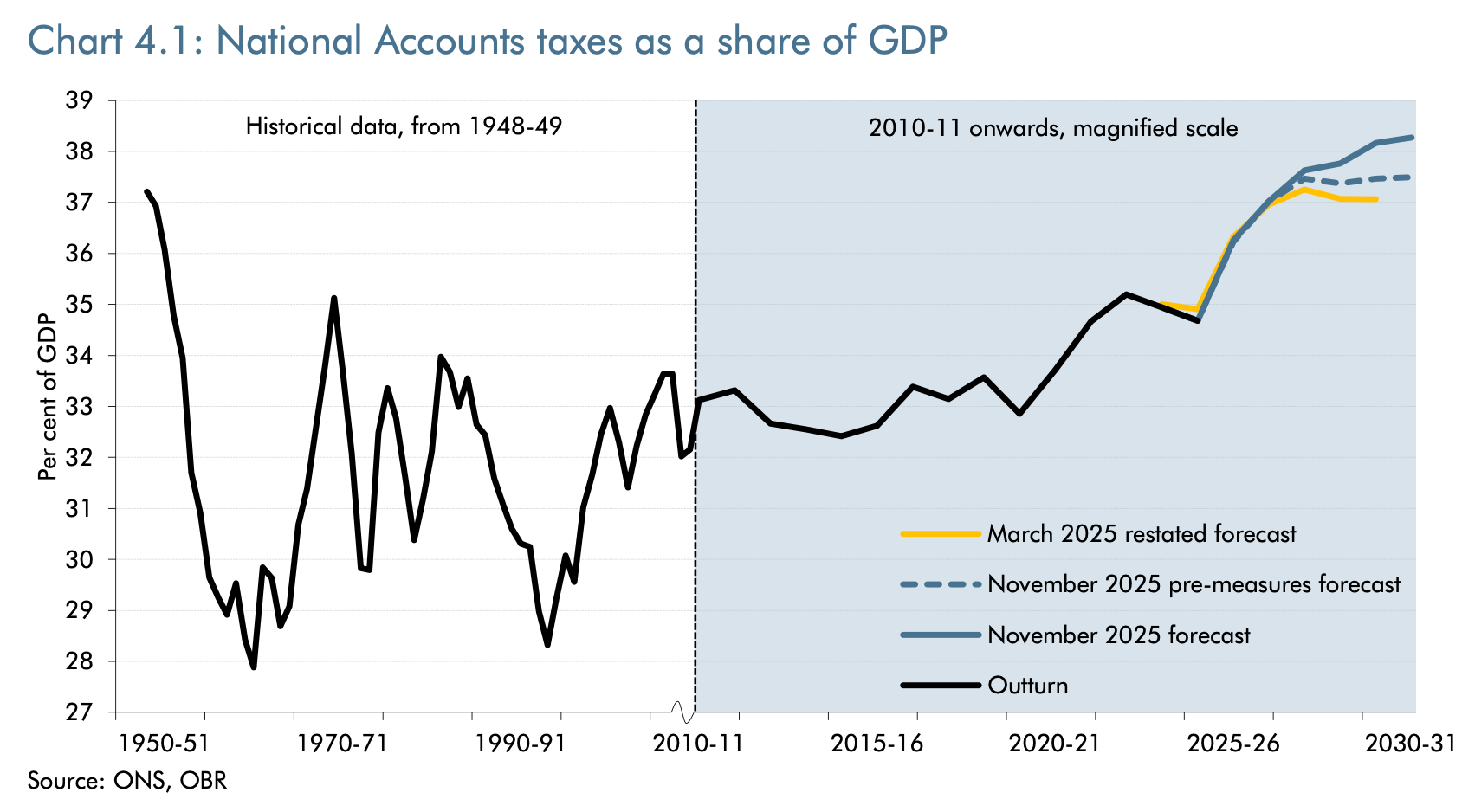
Taxes to hit all-time high says OBR. “The tax-to-GDP ratio is forecast to increase to an all-time high of 38.3 per cent of GDP in 2030-31”. The IFS says Reeves has now also set another record: she has already raised tax more than any other Chancellor in modern times. So: record rises in tax, record levels of tax.
Fiscal drag: around 5.2m more will be dragged into paying income tax by 2030-31 due to threshold freezes, with 4.8 million more becoming higher-rate taxpayers and 600,000 more paying the additional rate. That’s since Sunak started to freeze thresholds in 2022, and gives an indication of how many people will be stung by the stealth taxes Reeves has extended (after promising not to do so).
Significant downgrade to living standards / disposable income. Real household disposable income per person will grow at an anaemic 0.5pc per year over the forecast, vs the last decade’s average of 1pc a year. The OBR explicitly states: “Weaker medium-term real wage growth and rising taxes explain the slower growth”. This is the domestic cost-of-living angle - even as the economy grows, living standards barely improve because the Government is taking so much in tax. (Par 1.9)
Much more welfare: The removal of the two-child limit in Universal Credit will give more welfare to 560,000 families by an average of £5,310 per year by 2029-30, at a cost of £3 billion annually. The sum will be far more in some cases: there are something like 75,000 families living on welfare with five children or more. Combined with the reversal of winter fuel and disability benefit cuts (costing £7 billion in 2029-30), total welfare spending measures cost £9 billion by end of forecast. This represents a major U-turn on welfare austerity reform in June. All told, welfare costs are set to rise by £73bn to £406bn (!) over the next five years alone.
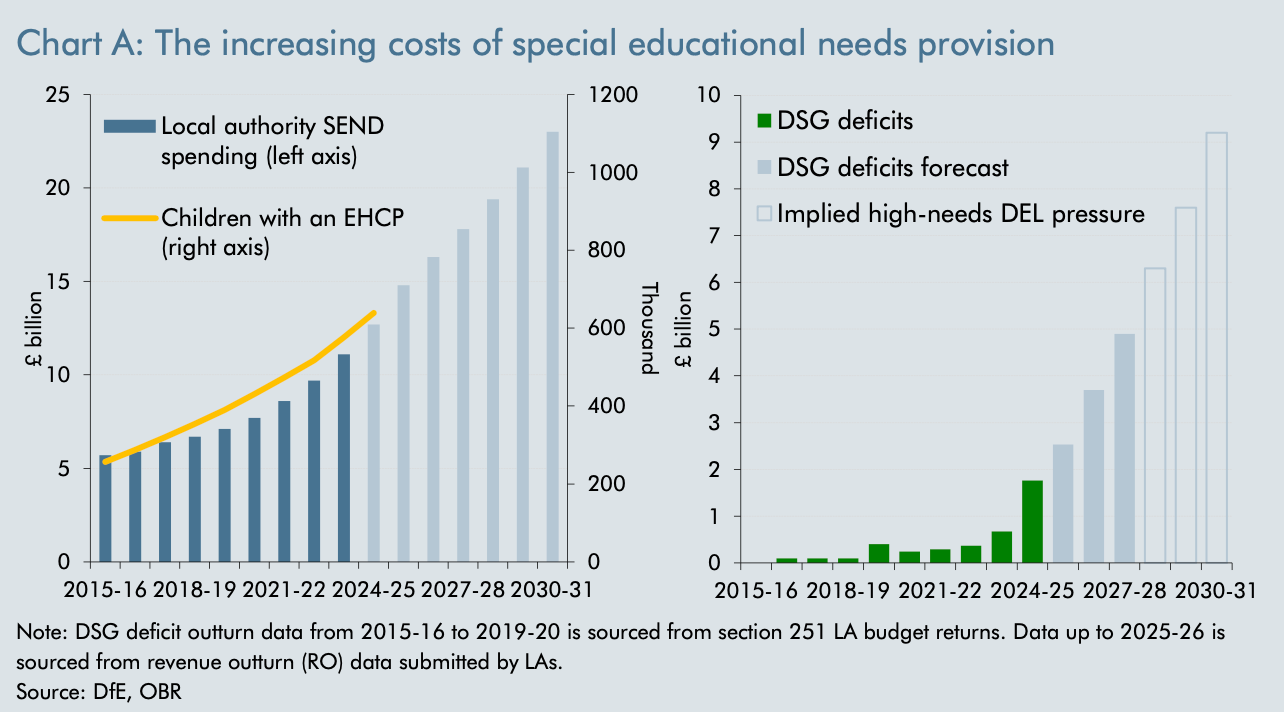
A new schools crisis - and a bailout of local authorities. The OBR details a special educational needs crisis, spending more than doubling over this plt. The OBR reveals a fiscal timebomb: £14 billion in accumulated local authority SEND deficits accumulating by 2027-28, currently masked by the statutory override that expires March 2028. Reeves “solution” transfers SEND funding to central government from 2028-29 at £6 billion cost, but with zero savings to pay for it. This simply moves the crisis from council balance sheets to departmental budgets. SEND caseloads exploded from 256k pupils in 2016 to 639k now – a 150% increase – but funding didn’t match. HMG has no reform plan today, merely kicking the problem forward from local councils to the centre. The OBR notes “no savings have been identified to offset the estimated 6£ billion pressure”. This represents either future departmental cuts in NHS, defence, or other services – or more tax rises.
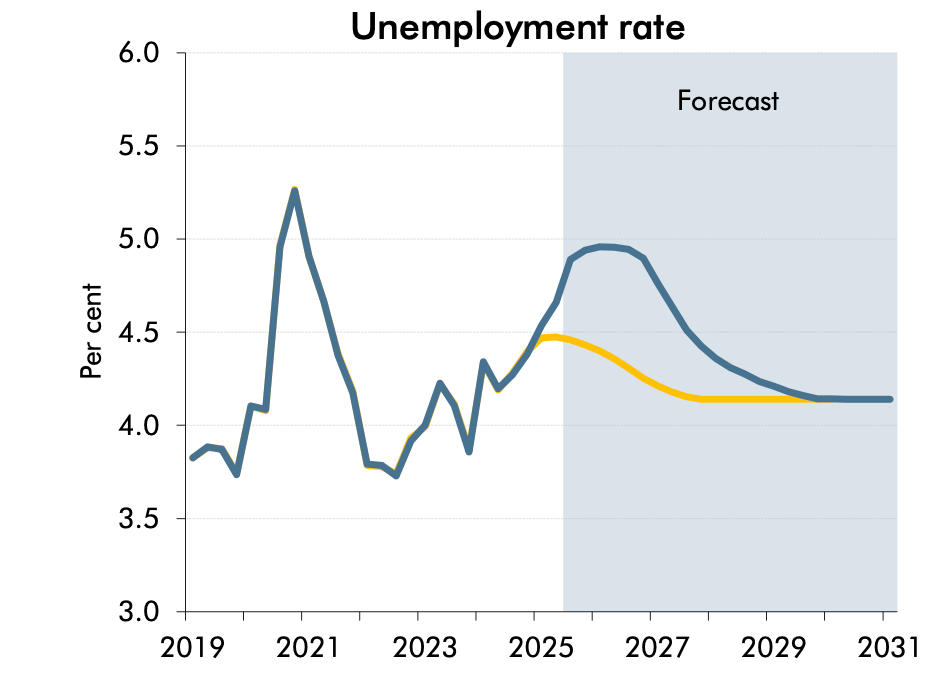
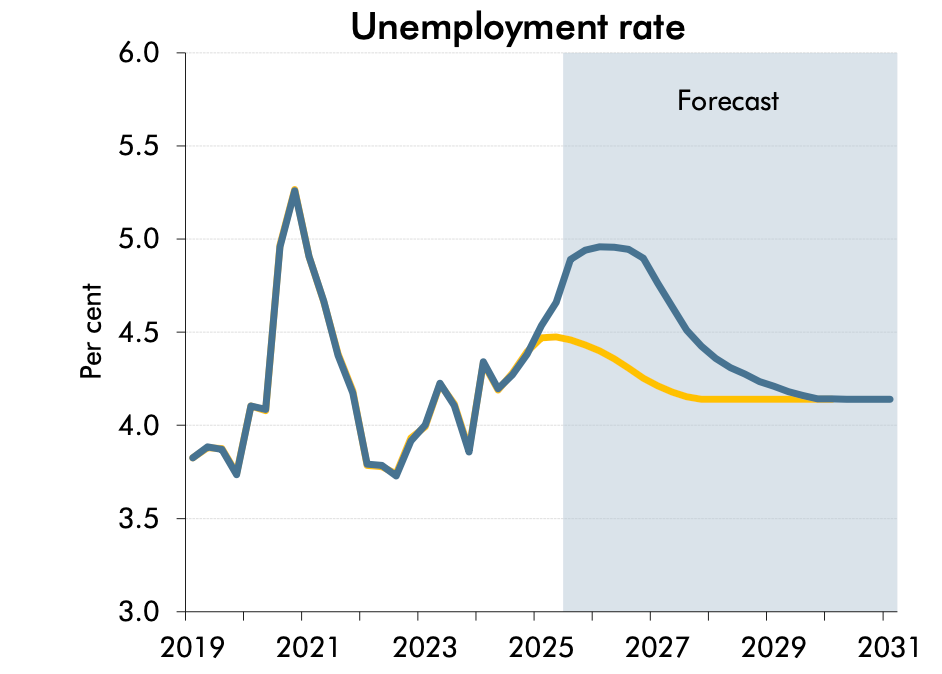
RIP Starmer’s employment goal The PM’s most noble mission, in my view, was to lift the employment rate to 80pc which would mean creating a million new jobs. The OBR projections suggest there is now no realistic chance of this. The jobs graph looks like an ICU monitor going dead.
Unemployment up an extra 240,000 next year alone (!) staying north of 5pc for a while. Risen from a 3.8pc post-pandemic trough in 2022 to 5pc now and is forecast to stay around that level until 2027. The OBR describes labour market conditions as “loose” with “weak labour demand”. This translates to around 240,000 more people unemployed than in March forecasts. The OBR notes that “entrants into the labour force are struggling to find work amid subdued demand for hiring” – suggesting the jobs crisis is hitting new entrants worse. The yellow line is the OBR Mar25 forecast, vs blue (today’s forecast).
New EV tax: As expected, EV drivers face a mileage-based charge of 3p per mile (1.5p for hybrids) from Apr28 An average driver doing 8,500 miles will pay £255 annually. This will raise £1.9 billion by 2030-31 but represents a landmark shift toward road pricing only covers one-quarter of the fuel duty revenues being lost to electric vehicles by 2050.
Asylum accommodation costs from triple over ten years. Seems the Home Office asylum accommodation bill has been revised sharply upward from £4.5 billion to £15.3 billion over ten years. This is a massive revision: suggests either the Home Office was wildly underestimating costs or asylum processing backlogs are worse than acknowledged. The OBR notes the Home Office is assuming it will “end the use of hotels for asylum seekers by mid-2028” – but this is a government assumption, not a costed commitment, creating a £1.1 billion fiscal risk if it fails
Those UK economic foundations are not being fixed. All this pain may be worth it if Britain was to move to a surer financial footing. To step back from the edge of its borrowing limit. Instead, Reeves has magnified Britain’s vulnerabilities. Look at the below. Britain now has the highest gilt yields (government borrowing costs) in the G7 because we’re seen to have the most vulnerable public finances in the G7…
And let’s look at Reeves new deficit forecasts: they are, each year, far worse than the plan she inherited from the Tories. I ran a quick comparison: Sunak in dark blue.
Business margins under pressure - and this matters. The real rate of return on capital is forecast to fall from around 12% in 2022 to a low of 10% in 2026. Not great for investment. The OBR’s verdict is stark: firms face genuine margin pressure because “real wage growth and settlement expectations hold up relative to subdued productivity growth”. Firms will eventually try to “rebuild their rate of return by keeping real wage growth below productivity growth” compounding the wage misery.
Collapse in household savings (p43) The OBR says household savings is forecast to plummet from 6pc in 2025 to just 2pc by 2030. So people will be cutting savings to adjust to the living standards squeeze - and I wonder if, by the next election, if they’ll be feeling much better off.
Starmer’s pledge to “Kickstart economic growth” has ended up downgrading growth. As you might expect given the far larger commitment to welfare spending. In GDP terms, or GDP per capita, the economy is now expected to grow at an even worse rate than the one he inherited.
The public mood is shifting - and a taxpayer rebellion may now start to take shape. Every year the British Social Attitudes Survey asks about tax and spend levels: the answers often presage a change in government. What Reeves has done will go down well with her party. But the mood in the country is changing - and given today’s gravel-dump of misery, the below trends may well continue.
Reeves will probably be back for more. The absence of a growth agenda will bring further problems later, which will lead to more costs - and Reeves has shown that she responds to such pressure by raising tax (in the belief that her backbenchers will not tolerate expenditure reform). She’ll run out of room before long. The Budget may have doubled her fiscal headroom (ie, overdraft limit) to £22 billion, the OBR notes this is only “two-fifths” of the median £54 billion difference between its four-year forecasts and actual outturn. (1.24, p14). Her probability of meeting the fiscal mandate is just 59pc – and this is described as “its highest level since before the pandemic”. The public finances remain “relatively vulnerable to future shocks.” (p18, 1.30).
To quote Noel Coward: there may be more bad times just around the corner…
PS - The tax graph….
PPS On that budget leak… The OBR has apparently called in an ex-GCHQ spook to find out who leaked their report. I can save them some time. In my old job, we had ~30 mins to write up the Budget after the Chancellor stood down. Every second counted. We used to nominate a ‘running man’ who’d bring the document back from the Commons. We had to stop after the exertion almost killed one of them but in later years I worked out that the URL was always the same. For example:-
Last year’s: https://obr.uk/docs/dlm_uploads/OBR_Economic_and_fiscal_outlook_Oct_2024.pdf
And this year’s (surprise!)
https://obr.uk/docs/dlm_uploads/OBR_Economic_and_fiscal_outlook_November_2025.pdf
Who’d have thunk? It’s an old data-journalism trick: guess the URL then go fishing. Code up a bot to do the scraping, get it to keep trying, wait for the link to go live. Plug in into an auto-analysis bot to get the headlines.
This works because URLs are never coded with security in mind: the dutiful, protocol-following web team just follow protocol. So a bot can be written to scan, and download the OBR report the second it drops. If I knew this, then I suspect Reuters knows this. The OBR made the link live without signposting it, thinking there’d be no direct traffic - and not knowing that we live in an age of data-scrapers (a basic tool in data journalism). A leak? Perhaps. But save GCHQ the trouble: a bedroom blogger could have guessed this one.
I love the (most likely) way the OBR report was “leaked” - it demonstrates yet again how naive government is when it comes to technology, which explains why they always get it wrong and why the budget always goes out of the window (looking at you MoD procurement).
I think the last stat, that the fiscal headroom is 2/5 of the median difference between OBR projection and actual growth historically, reveals that the Chancellor has failed to ensure she won't have to come back and replay this charade for a second time in a row.